How to Decide Between CSM vs CSPO for Your Career
How to Decide Between CSM vs CSPO for Your Career
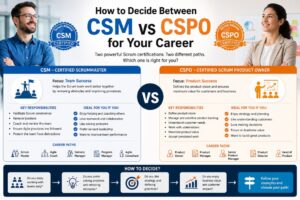
How to Decide Between CSM vs CSPO for Your Career, in today’s fast-changing Agile world, professionals are constantly looking for certifications that can help them grow their earning potential, and open new career opportunities. Among the most popular Agile certifications, CSM vs CSPO is one of the most debated topics. Many beginners, project managers, business analysts, developers, and aspiring product professionals often wonder which certification is the better choice for their career.
The truth is that there is no universal answer. The right certification depends on your career goals, interests, current experience, and the type of work you enjoy. While both certifications are respected worldwide, they prepare professionals for completely different responsibilities within Agile teams.
This comprehensive guide will help you understand the differences between CSM vs CSPO, explore their career opportunities, compare salaries, identify required skills, and ultimately decide which certification aligns best with your professional aspirations.
Understanding Agile Before Comparing CSM vs CSPO
Before comparing these certifications, it’s important to understand the Agile framework itself.
Agile is a project management and software development methodology that focuses on collaboration, flexibility, customer feedback, and continuous improvement. Instead of spending months building a complete product before receiving customer feedback, Agile teams work in short iterations called sprints.
Within Scrum—the most popular Agile framework—every member has clearly defined responsibilities. Two of the most important roles are:
- Scrum Master
- Product Owner
These two roles are represented by the certifications:
- Certified ScrumMaster (CSM)
- Certified Scrum Product Owner (CSPO)
Although both belong to Scrum, they focus on entirely different aspects of product development.
What is CSM?
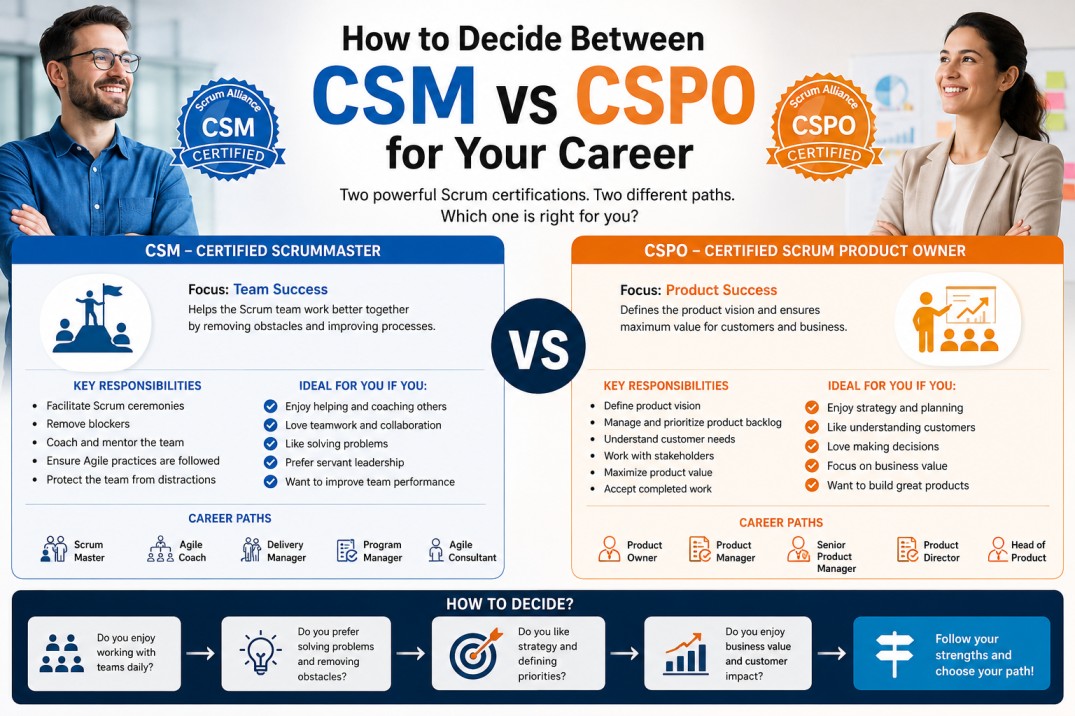
The Certified ScrumMaster (CSM) certification is designed for professionals who want to become Scrum Masters.
A Scrum Master acts as a servant leader for the Scrum team. Their primary responsibility is ensuring that Scrum principles are followed correctly while helping the team remove obstacles that slow progress.
Rather than managing people, Scrum Masters coach teams, facilitate meetings, and encourage collaboration.
Typical responsibilities include:
- Facilitating Scrum ceremonies
- Removing blockers
- Coaching Agile practices
- Helping teams improve continuously
- Protecting developers from distractions
- Supporting communication between stakeholders
The Scrum Master focuses on improving the team’s productivity rather than making business decisions.
What is CSPO?
The Certified Scrum Product Owner (CSPO) certification prepares professionals to become Product Owners.
Unlike Scrum Masters, Product Owners are responsible for maximizing product value.
They work closely with customers, stakeholders, executives, designers, developers, and business teams to ensure the product solves real customer problems.
Key responsibilities include:
- Creating product vision
- Managing product backlog
- Prioritizing features
- Working with stakeholders
- Defining business value
- Accepting completed work
- Guiding product strategy
The Product Owner bridges the gap between business needs and development teams.
CSM vs CSPO: The Core Difference
Although both certifications belong to Scrum, their responsibilities are significantly different.
| Feature | CSM | CSPO |
|---|---|---|
| Primary Focus | Team Success | Product Success |
| Main Responsibility | Facilitate Scrum | Deliver Business Value |
| Works Closely With | Development Team | Customers & Stakeholders |
| Goal | Improve Team Performance | Build the Right Product |
| Leadership Style | Servant Leadership | Strategic Leadership |
| Decision Making | Process Decisions | Product Decisions |
This comparison highlights why the CSM vs CSPO debate depends entirely on your career interests rather than which certification is “better.”
Who Should Choose CSM?
CSM is ideal for professionals who enjoy working directly with teams.
You may enjoy becoming a Scrum Master if you:
- Love helping others succeed
- Enjoy coaching people
- Like solving problems
- Prefer collaboration over authority
- Want to improve team efficiency
- Enjoy facilitating meetings
- Like mentoring teams
Professionals who often choose CSM include:
- Project Managers
- Team Leads
- Engineering Managers
- Developers
- QA Engineers
- Delivery Managers
- Agile Coaches
Who Should Choose CSPO?
CSPO is better suited for professionals interested in business strategy and product development.
You should consider CSPO if you enjoy:
- Understanding customer needs
- Creating product roadmaps
- Defining product vision
- Prioritizing features
- Making business decisions
- Market research
- Product innovation
Professionals who typically pursue CSPO include:
- Product Managers
- Business Analysts
- Entrepreneurs
- Product Owners
- Marketing Professionals
- UX Professionals
- Startup Founders
Skills Required for CSM
To become an effective Scrum Master, you’ll need several soft and technical skills.
These include:
Leadership
Scrum Masters lead without authority.
Communication
Excellent communication helps coordinate teams and stakeholders.
Coaching
Helping teams continuously improve is a major responsibility.
Conflict Resolution
Healthy conflict management keeps projects moving.
Facilitation
Running Sprint Planning, Daily Standups, Sprint Reviews, and Retrospectives requires facilitation skills.
Problem Solving
Removing blockers quickly improves productivity.
Skills Required for CSPO
A Product Owner requires a different skill set.
Important skills include:
Strategic Thinking
Understanding long-term business goals.
Customer Research
Knowing customer pain points.
Product Vision
Creating clear direction for the product.
Prioritization
Deciding what features matter most.
Market Analysis
Studying competitors and industry trends.
Decision Making
Making informed product choices under uncertainty.
Career Opportunities in CSM vs CSPO
Both certifications open excellent career opportunities.
Career Paths After CSM
Professionals often move into roles such as:
- Scrum Master
- Agile Coach
- Delivery Manager
- Program Manager
- Agile Consultant
- Transformation Coach
Career Paths After CSPO
CSPO professionals commonly become:
- Product Owner
- Product Manager
- Senior Product Manager
- Product Director
- Head of Product
- Chief Product Officer
The CSM vs CSPO decision often depends on whether you see yourself leading people or leading products.
Salary Comparison
Salary varies by country, experience, industry, and company.
Generally speaking:
CSM professionals earn competitive salaries because Agile transformation continues across industries.
CSPO professionals often earn slightly higher salaries in product-driven organizations because they directly influence business strategy and revenue.
However, experienced Scrum Masters working as Agile Coaches can also command exceptionally high salaries.
Rather than focusing only on salary, consider which daily responsibilities you’ll enjoy more.
Which Certification Is Easier?
Many professionals ask whether CSM or CSPO is easier.
The answer depends on your background.
If you enjoy teamwork, coaching, and Agile processes, CSM may feel more natural.
If you enjoy business strategy, customer research, and product planning, CSPO may seem easier.
Neither certification is inherently difficult. Both are designed to provide practical knowledge rather than advanced technical expertise.
Can You Do Both?
Absolutely.
Many Agile professionals eventually earn both certifications.
Starting with one certification doesn’t limit your future.
For example:
- A Scrum Master can later become a Product Owner.
- A Product Owner can learn Scrum facilitation by earning CSM.
Having both certifications demonstrates versatility and broad Agile knowledge.
Questions to Ask Yourself
Before deciding between CSM vs CSPO, ask yourself these questions:
Do you enjoy helping teams succeed every day?
Or do you prefer defining product strategy and customer value?
Would you rather facilitate meetings?
Or prioritize product features?
Do you enjoy coaching people?
Or making business decisions?
Your answers will usually point toward the right certification.
Industries That Hire CSM Professionals
CSM certification is valuable across many industries, including:
- Information Technology
- Healthcare
- Banking
- Finance
- Insurance
- Telecommunications
- Government
- Manufacturing
- Education
- Retail
Agile practices continue expanding beyond software development, increasing demand for Scrum Masters.
Industries That Hire CSPO Professionals
Product Owners are increasingly needed in:
- SaaS Companies
- FinTech
- Healthcare Technology
- E-commerce
- Artificial Intelligence
- EdTech
- Gaming
- Mobile Apps
- Startups
- Enterprise Software
Organizations developing digital products heavily rely on Product Owners.
Common Mistakes When Choosing Between CSM vs CSPO
Many professionals choose a certification based solely on salary or popularity.
Instead, avoid these mistakes:
- Choosing based only on income
- Following friends without considering your interests
- Ignoring your strengths
- Assuming one role is superior
- Believing certifications alone guarantee employment
Practical experience, communication skills, and continuous learning remain essential regardless of certification.
Future Demand
Both Scrum Masters and Product Owners continue to be in high demand as organizations embrace Agile transformation.
Companies increasingly seek professionals who can improve collaboration, accelerate product delivery, and create customer-focused solutions.
As Agile evolves, professionals with either certification—and especially those who combine technical knowledge with strong business and leadership skills—will remain highly valuable.
Final Thoughts
The debate around CSM vs CSPO isn’t about choosing the better certification—it’s about choosing the right path for your career.
If you’re passionate about coaching teams, improving collaboration, and ensuring Agile practices are followed effectively, the Certified ScrumMaster (CSM) certification is an excellent fit.
On the other hand, if you’re excited by product strategy, customer insights, business value, and shaping the direction of innovative products, the Certified Scrum Product Owner (CSPO) certification is likely the better choice.
Ultimately, your success depends less on the certificate itself and more on how well your chosen role aligns with your interests, strengths, and long-term career goals. By understanding the unique responsibilities of each role, you can confidently choose between CSM vs CSPO and take the next step toward a rewarding career in Agile.