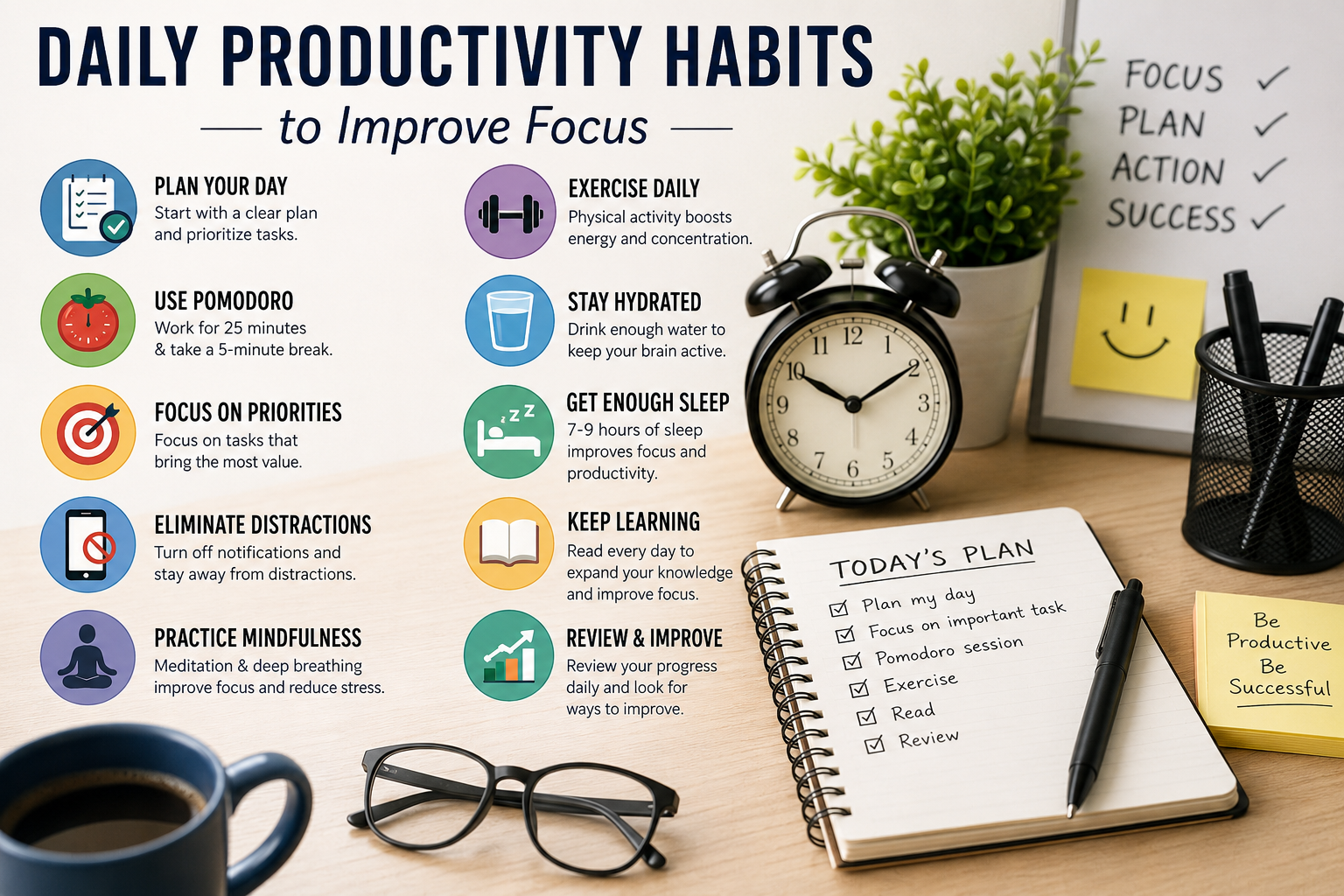
Daily Productivity Habits to Improve Focus
Daily Productivity Habits to Improve Focus
Introduction
In today’s fast-moving world, staying focused has become one of the biggest challenges for students, professionals, entrepreneurs, and even homemakers. Notifications, social media, endless emails, and constant distractions make it difficult to complete even simple tasks. This is why developing daily productivity habits is no longer optional—it’s essential for achieving personal and professional success.
The good news is that improving focus doesn’t require dramatic lifestyle changes. Small, consistent habits practiced every day can significantly enhance concentration, reduce stress, and help you accomplish more in less time. Instead of relying on motivation, which often comes and goes, successful people build routines that naturally improve productivity.
In this article, we’ll explore practical daily productivity habits that can transform your focus, explain why they work, and provide reliable resources where you can learn more about each strategy.
Why Focus Matters
Focus is the ability to direct your attention toward one task without being distracted. When your mind stays focused, you complete work faster, make fewer mistakes, and experience less mental fatigue.
According to research from the American Psychological Association, multitasking actually reduces productivity because the brain constantly switches between tasks rather than performing them simultaneously.
Learn more:
https://www.apa.org/topics/research/multitasking
1. Start Your Day with a Clear Plan
One of the most effective daily productivity habits is planning your day before jumping into work.
Instead of reacting to whatever comes your way, spend 10–15 minutes creating a list of your most important tasks.
How to do it:
- Write down everything you need to complete.
- Highlight the top three priorities.
- Estimate how long each task will take.
- Schedule them on your calendar.
Planning reduces decision fatigue and gives your brain a clear direction from the start.
Useful tool:
https://todoist.com/
2. Follow the 80/20 Rule
The Pareto Principle states that 80% of your results come from 20% of your efforts.
Ask yourself:
- Which task creates the biggest impact?
- What activity moves me closer to my goals?
Instead of staying busy all day, focus on meaningful work.
Read more:
https://asana.com/resources/pareto-principle-80-20-rule
3. Practice Time Blocking
Time blocking means assigning specific time slots to specific tasks.
Example:
- 9:00–10:30 Deep Work
- 10:30–11:00 Emails
- 11:00–12:00 Meetings
This method prevents constant task switching and helps improve concentration.
Google Calendar:
https://calendar.google.com/
4. Eliminate Digital Distractions
Your smartphone can destroy your concentration within seconds.
Turn off:
- Social media notifications
- Unnecessary app alerts
- Email popups
Use Focus Mode on your phone or website blockers while working.
Recommended tool:
https://freedom.to/
5. Use the Pomodoro Technique
The Pomodoro Technique is one of the most popular daily productivity habits for improving focus.
Work for:
- 25 minutes
- Take a 5-minute break
Repeat four cycles, then take a longer break.
This prevents mental exhaustion while keeping productivity high.
Official website:
https://francescocirillo.com/pages/pomodoro-technique
6. Keep Your Workspace Organized
A cluttered desk often leads to a cluttered mind.
Every morning:
- Remove unnecessary items.
- Clean your desk.
- Keep only essential tools nearby.
A clean environment improves mental clarity and reduces distractions.
Research:
https://www.princeton.edu/news/2011/01/10/why-clutter-disrupts-your-brain
7. Prioritize Deep Work
Deep work means focusing on one demanding task without interruptions.
Author Cal Newport explains that uninterrupted concentration creates better results in less time.
During deep work:
- Silence your phone.
- Close unnecessary tabs.
- Avoid checking messages.
Learn more:
https://calnewport.com/
8. Get Enough Sleep
No productivity hack can replace quality sleep.
Adults generally need 7–9 hours of sleep each night.
Poor sleep reduces:
- Memory
- Decision-making
- Creativity
- Attention span
Healthy sleep improves overall productivity.
Sleep Foundation:
https://www.sleepfoundation.org/
9. Exercise Daily
Physical activity improves blood circulation to the brain, increasing alertness and focus.
Even a 20-minute walk can improve concentration.
Recommended activities:
- Walking
- Cycling
- Yoga
- Stretching
Benefits explained:
https://www.cdc.gov/physicalactivity/
10. Stay Hydrated
The brain is highly sensitive to dehydration.
Even mild dehydration can affect:
- Memory
- Mood
- Focus
Drink water throughout the day instead of waiting until you feel thirsty.
More information:
https://www.healthline.com/nutrition/7-health-benefits-of-water
11. Eat Brain-Friendly Foods
Nutrition directly affects productivity.
Foods that improve focus include:
- Eggs
- Nuts
- Fish
- Blueberries
- Green vegetables
- Dark chocolate
Healthy eating supports better mental performance.
Nutrition guide:
https://www.hsph.harvard.edu/nutritionsource/
12. Learn to Say No
Many people lose focus because they commit to too many responsibilities.
Before accepting a new task, ask:
- Is this important?
- Does it align with my goals?
- Can it wait?
Protecting your schedule is one of the smartest daily productivity habits.
13. Limit Multitasking
Although multitasking seems efficient, research shows it reduces performance.
Instead:
- Finish one task.
- Then move to the next.
Single-tasking helps you produce higher-quality work.
Research:
https://www.apa.org/topics/research/multitasking
14. Take Meaningful Breaks
Breaks improve mental energy.
Avoid spending breaks scrolling social media.
Instead:
- Walk outside.
- Stretch.
- Drink water.
- Practice deep breathing.
Returning refreshed increases productivity.
15. Practice Mindfulness
Mindfulness trains your brain to stay present.
Just five to ten minutes of meditation daily can improve concentration and reduce stress.
Beginner meditation:
https://www.headspace.com/
16. Review Your Day
Every evening, spend five minutes reflecting.
Ask yourself:
- What did I accomplish?
- What distracted me?
- What should I improve tomorrow?
Reflection helps build better daily productivity habits over time.
17. Read Every Day
Reading strengthens attention span.
Choose books related to:
- Productivity
- Leadership
- Personal development
- Psychology
Reading for just 20 minutes daily expands knowledge while improving focus.
Goodreads:
https://www.goodreads.com/
18. Set SMART Goals
SMART goals are:
- Specific
- Measurable
- Achievable
- Relevant
- Time-bound
Instead of saying:
“I’ll work harder.”
Say:
“I’ll complete two important reports before 3 PM.”
Goal-setting guide:
https://www.mindtools.com/pages/article/smart-goals.htm
19. Avoid Perfectionism
Perfection often delays progress.
Instead of waiting for everything to be perfect:
- Start.
- Improve later.
- Learn through action.
Done is usually better than perfect.
20. Build Consistency Instead of Motivation
Motivation changes every day.
Habits remain.
Successful people don’t rely on feeling motivated—they rely on routines.
Start with small actions:
- Wake up at the same time.
- Plan your day.
- Exercise.
- Read.
- Complete one important task first.
Over weeks and months, these routines become automatic.
How Daily Productivity Habits Shape Long-Term Success
One of the greatest benefits of building daily productivity habits is that they create lasting success over time. Many people believe that achieving big goals requires extraordinary effort, but in reality, small consistent actions often produce the biggest results. When you wake up at the same time each day, plan your priorities, avoid distractions, and dedicate focused time to important tasks, you are strengthening habits that become automatic. These routines reduce the need for constant motivation because your daily schedule begins to guide your actions naturally. Whether you’re a student preparing for exams, a business owner managing multiple responsibilities, or a remote worker balancing deadlines, following strong daily productivity habits helps you stay organized and focused. Over weeks and months, these habits compound, allowing you to complete more meaningful work while experiencing less stress and mental fatigue. Instead of chasing quick productivity hacks, focus on creating routines that you can maintain consistently, as long-term discipline is far more valuable than short bursts of motivation.
Technology Can Support Your Daily Productivity Habits
Technology is often blamed for reducing attention spans, but when used wisely, it can actually strengthen your daily productivity habits. Productivity apps, digital calendars, note-taking tools, and habit trackers make it easier to organize your day and stay accountable. For example, applications like Notion, Todoist, and Google Calendar allow you to manage projects, schedule important tasks, and track your progress efficiently. However, it’s equally important to control technology rather than letting it control you. Set specific times to check emails and social media instead of responding to every notification immediately. Using focus modes, website blockers, or app timers can help minimize unnecessary interruptions during work sessions. If you’re looking to explore useful productivity tools, you can visit Notion (https://www.notion.so/), Todoist (https://todoist.com/), or Google Calendar (https://calendar.google.com/). By combining smart technology with healthy routines, you can build sustainable daily productivity habits that improve concentration, increase efficiency, and help you achieve your personal and professional goals with greater confidence.
Bonus Tips for Better Focus
Additional daily productivity habits include:
- Keep your phone away while working.
- Use headphones if your environment is noisy.
- Batch similar tasks together.
- Reduce unnecessary meetings.
- Celebrate small achievements.
- Track your progress weekly.
- Avoid checking email first thing in the morning.
Common Productivity Mistakes
Avoid these habits:
- Sleeping late every night
- Constantly checking notifications
- Working without a plan
- Skipping breaks
- Trying to multitask
- Overloading your schedule
- Ignoring physical health
Removing these bad habits is just as important as building good ones.
Final Thoughts
Developing strong daily productivity habits is one of the best investments you can make in yourself. Productivity isn’t about working longer hours—it’s about working smarter with greater focus and intention. Small actions like planning your day, reducing distractions, getting enough sleep, exercising, and practicing mindfulness can create lasting improvements in your efficiency and overall well-being.
Remember that lasting change doesn’t happen overnight. Start by choosing just two or three habits from this guide and practice them consistently. As these habits become part of your routine, gradually introduce new ones. Over time, you’ll notice better concentration, higher-quality work, reduced stress, and greater confidence in your ability to achieve your goals.
The key to success is consistency. Keep improving one day at a time, and your daily productivity habits will become the foundation of a more focused, productive, and fulfilling life.
For more: click here