Social Security Benefits: Eligibility and Payments
Social Security Benefits: Eligibility and Payments
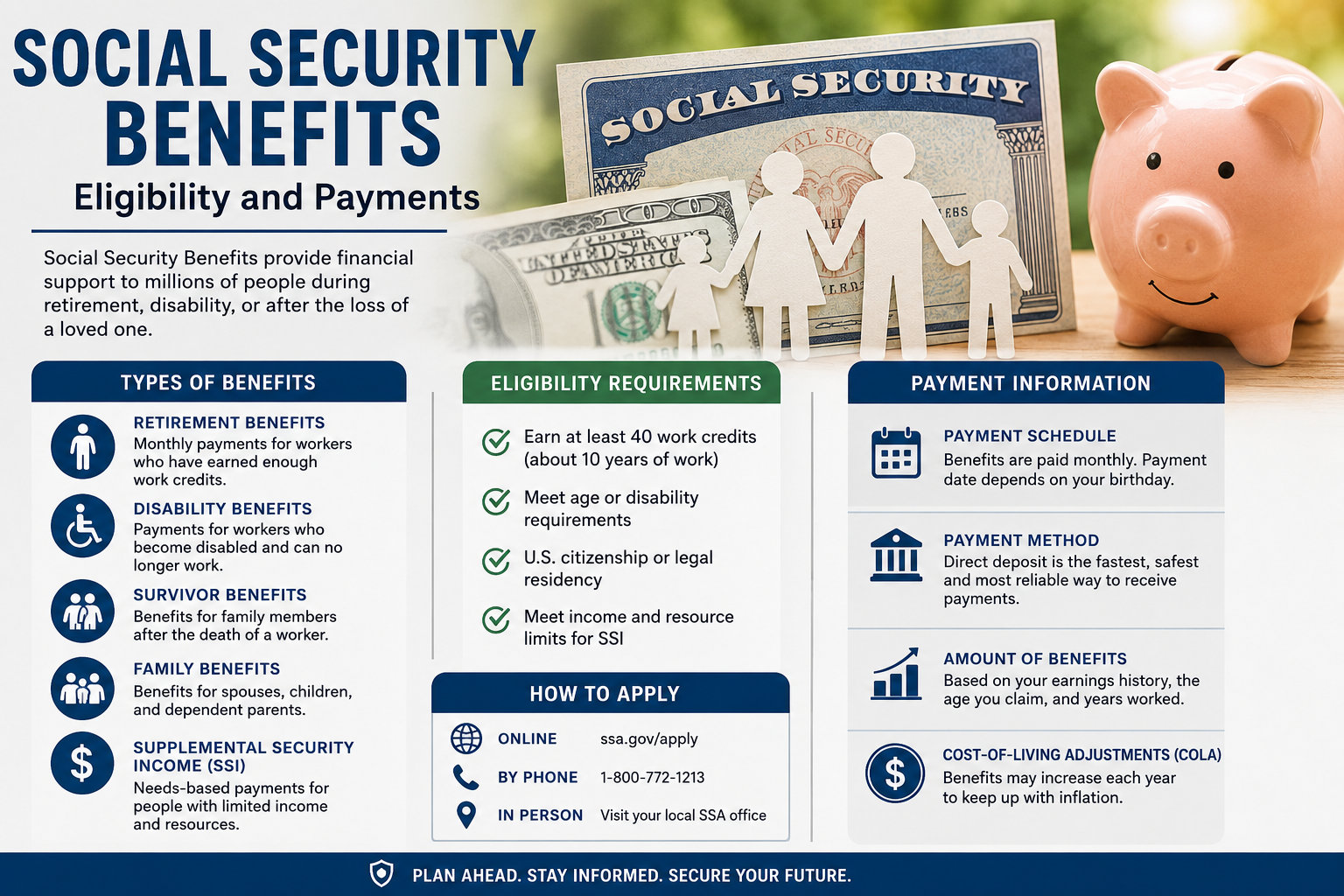
Social Security Benefits provide financial support to millions of Americans every month. Whether you are planning for retirement, living with a disability, or supporting a family after the loss of a loved one, these benefits can help provide financial stability.
The Social Security program is managed by the U.S. Social Security Administration (SSA) and is primarily funded through payroll taxes. Workers earn credits throughout their careers by paying Social Security taxes, and these credits determine eligibility for various benefits.
In this comprehensive guide, you’ll learn who qualifies for Social Security Benefits, how payments are calculated, when benefits begin, and how to maximize your monthly income.
What Are Social Security Benefits?
Social Security Benefits are monthly payments provided by the U.S. government to eligible individuals and their families. The program was created under the Social Security Act of 1935 to provide financial protection during retirement and in situations involving disability or death.
The program covers several categories of beneficiaries:
- Retirement Benefits
- Disability Benefits (SSDI)
- Survivor Benefits
- Family Benefits
- Supplemental Security Income (SSI)
Official Source:
https://www.ssa.gov/benefits/
Why Are Social Security Benefits Important?
Social Security Benefits play a major role in helping millions of Americans maintain financial security after retirement or during difficult life circumstances.
Some key advantages include:
- Monthly guaranteed income
- Protection against poverty during retirement
- Financial support for disabled workers
- Survivor benefits for families
- Annual Cost-of-Living Adjustments (COLA)
For many retirees, Social Security is their primary source of income.
Types of Social Security Benefits
Understanding the different types of Social Security Benefits helps you determine which program applies to your situation.
1. Retirement Benefits
Retirement Benefits are available to workers who have earned enough work credits through employment.
Generally, workers need 40 work credits, which usually equals about 10 years of work, to qualify.
The age at which you claim benefits significantly affects your monthly payment.
- Early Retirement (Age 62)
- Full Retirement Age (66–67 depending on birth year)
- Delayed Retirement (up to age 70)
Waiting longer generally increases your monthly benefit.
Official Retirement Information:
https://www.ssa.gov/retirement
2. Social Security Disability Insurance (SSDI)
SSDI provides monthly payments to workers who become disabled before reaching retirement age.
To qualify, applicants generally must:
- Have a qualifying disability
- Be unable to perform substantial work
- Have earned sufficient work credits
- Meet SSA medical requirements
Unlike retirement benefits, SSDI is based on your work history rather than your current income.
Learn more:
https://www.ssa.gov/disability
3. Survivor Benefits
If a worker dies after earning enough Social Security credits, certain family members may receive Survivor Benefits.
Eligible individuals include:
- Widows
- Widowers
- Minor children
- Disabled children
- Dependent parents
These benefits help families replace lost income after the death of a wage earner.
Official Information:
https://www.ssa.gov/survivor
4. Family Benefits
Certain family members can receive benefits based on another worker’s earnings record.
Examples include:
- Spouses
- Divorced spouses (under specific conditions)
- Children
- Dependent parents
The amount depends on the worker’s earnings history and the family relationship.
5. Supplemental Security Income (SSI)
Although many people confuse SSI with Social Security retirement benefits, they are separate programs.
SSI is designed for individuals with:
- Limited income
- Limited financial resources
- Disability
- Blindness
- Age 65 or older
SSI is funded through general tax revenues rather than Social Security payroll taxes.
Official SSI Information:
https://www.ssa.gov/ssi
Who Is Eligible for Social Security Benefits?
Eligibility depends on the specific benefit program.
Retirement Eligibility
Generally, you need:
- 40 work credits
- At least age 62 to begin benefits
- Full Retirement Age for full benefits
Disability Eligibility
Applicants must:
- Meet SSA disability requirements
- Have enough recent work credits
- Be unable to engage in substantial gainful activity
Survivor Eligibility
Family members may qualify if the deceased worker earned enough Social Security credits before death.
SSI Eligibility
Applicants must meet:
- Income limits
- Resource limits
- Residency requirements
- Citizenship or qualifying immigration status
Eligibility details:
https://www.ssa.gov/benefits/retirement/planner/credits.html
How Work Credits Are Earned
Work credits are the foundation of Social Security eligibility.
Workers earn credits by paying Social Security taxes through employment or self-employment.
Each year, the amount required to earn one credit is adjusted for inflation.
Most workers earn the maximum four credits per year.
Official Work Credits Guide:
https://www.ssa.gov/benefits/retirement/planner/credits.html
How Social Security Payments Are Calculated
Many people wonder why benefit amounts vary from person to person.
Several factors influence your monthly payment.
Lifetime Earnings
Your highest earning years are used when calculating benefits.
Higher lifetime earnings generally result in larger monthly payments.
Retirement Age
Claiming benefits at age 62 permanently reduces monthly payments.
Waiting until Full Retirement Age allows you to receive 100% of your calculated benefit.
Delaying benefits until age 70 increases monthly payments through delayed retirement credits.
Cost-of-Living Adjustments (COLA)
Each year, Social Security payments may increase based on inflation.
These annual increases help beneficiaries maintain purchasing power despite rising living costs.
Learn more about COLA:
https://www.ssa.gov/cola/
When Should You Claim Social Security Benefits?
Choosing the right claiming age is one of the most important financial decisions.
Claim at Age 62
Pros:
- Receive benefits earlier
- Helpful if you need immediate income
Cons:
- Permanent reduction in monthly benefits
Claim at Full Retirement Age
Pros:
- Receive your full calculated benefit
- No early retirement reduction
Delay Until Age 70
Pros:
- Highest monthly payment
- Larger lifetime benefits if you live longer
The best age depends on your health, financial needs, employment plans, and expected lifespan.
How to Apply for Social Security Benefits
Applying for Social Security Benefits is easier than ever. The Social Security Administration (SSA) allows eligible individuals to apply online, by phone, or in person at a local Social Security office.
1. Apply Online
The fastest and most convenient way to apply is through the SSA’s official website.
Official Application Portal:
https://www.ssa.gov/apply
2. Apply by Phone
You can call the Social Security Administration and complete your application with the help of a representative.
Official Contact Information:
https://www.ssa.gov/agency/contact/
3. Apply in Person
If you prefer face-to-face assistance, schedule an appointment at your nearest Social Security office.
Find Your Local Office:
https://www.ssa.gov/locator/
Documents Required for Social Security Benefits
Before applying, gather all necessary documents to avoid delays.
Commonly required documents include:
- Social Security Number
- Birth Certificate
- Proof of U.S. Citizenship or Lawful Immigration Status
- W-2 Forms or Self-Employment Tax Returns
- Bank Account Information for Direct Deposit
- Marriage Certificate (if applicable)
- Military Service Records (if applicable)
Applicants for disability benefits may also need:
- Medical records
- Doctor reports
- Hospital records
- Prescription information
- Employment history
Having these documents ready helps speed up the application process.
How Long Does It Take to Receive Benefits?
The processing time depends on the type of benefit you apply for.
Typical timelines include:
- Retirement Benefits: Usually 1–2 months if you apply before your desired start date.
- Disability Benefits (SSDI): Often 3–6 months or longer because medical evidence must be reviewed.
- Survivor Benefits: Processing times vary based on individual circumstances.
- SSI Benefits: May take several months depending on financial and medical eligibility reviews.
The SSA may contact you if additional documentation is required.
Social Security Payment Schedule
Most beneficiaries receive payments once each month.
Payment dates depend on your birth date.
If Your Birthday Falls:
- 1st–10th: Payment on the second Wednesday
- 11th–20th: Payment on the third Wednesday
- 21st–31st: Payment on the fourth Wednesday
Some beneficiaries who started receiving benefits before May 1997 may receive payments on a different schedule.
Official Payment Calendar:
https://www.ssa.gov/pubs/calendar.htm
Maximum Social Security Benefit Amount
The amount you receive depends on several factors, including:
- Your lifetime earnings
- Your retirement age
- The number of years you worked
- The age at which you begin claiming benefits
Workers who consistently earned high incomes and delayed retirement until age 70 generally receive the highest monthly payments.
The SSA updates maximum benefit amounts each year.
Official Benefit Information:
https://www.ssa.gov/benefits/retirement/
Can You Work While Receiving Social Security Benefits?
Yes, but your age matters.
Before Full Retirement Age
If you claim benefits early and continue working, your benefits may be temporarily reduced if your earnings exceed the annual earnings limit set by the SSA.
After Full Retirement Age
Once you reach Full Retirement Age, there is no earnings limit. You can work and earn any amount without reducing your Social Security retirement benefits.
Learn More:
https://www.ssa.gov/benefits/retirement/planner/whileworking.html
Are Social Security Benefits Taxable?
Some beneficiaries must pay federal income tax on a portion of their Social Security Benefits.
Whether your benefits are taxable depends on:
- Your total annual income
- Your filing status
- Other retirement income
- Investment income
Depending on your combined income, up to 85% of your Social Security Benefits may be subject to federal income tax.
Tax Information:
https://www.irs.gov/taxtopics/tc423
Direct Deposit for Social Security Payments
The Social Security Administration strongly encourages beneficiaries to receive payments electronically.
Benefits of Direct Deposit include:
- Faster payments
- Improved security
- No risk of lost or stolen checks
- Convenient access to funds
You can update your banking information through your online SSA account.
Manage Your Account:
https://www.ssa.gov/myaccount/
Common Reasons Benefits May Be Delayed
Although most applications are processed successfully, delays can occur due to:
- Missing documents
- Incorrect application information
- Medical evidence review
- Identity verification issues
- High application volume
Providing accurate information and responding quickly to SSA requests can help avoid unnecessary delays.
Common Mistakes to Avoid
Many applicants unintentionally reduce their future benefits or delay approval.
Avoid these common mistakes:
- Claiming retirement benefits too early without understanding the permanent reduction.
- Forgetting to report changes in income or employment.
- Providing incomplete medical records for disability claims.
- Entering incorrect banking information.
- Missing SSA deadlines or requests for additional documents.
- Assuming SSI and Social Security Retirement Benefits are the same program.
Carefully reviewing your application before submission can save time and prevent issues.
Tips to Maximize Your Social Security Benefits
If you want to receive the highest possible monthly payment, consider these strategies:
- Work for at least 35 years, as benefits are based on your highest 35 years of earnings.
- Increase your lifetime earnings whenever possible.
- Delay claiming benefits until age 70 if financially feasible.
- Check your Social Security earnings record regularly for accuracy.
- Coordinate benefits with your spouse to maximize household income.
Planning ahead can significantly increase your lifetime Social Security income.
Frequently Asked Questions (FAQs)
What is the minimum age to claim Social Security retirement benefits?
You can begin receiving retirement benefits as early as age 62, although claiming before your Full Retirement Age permanently reduces your monthly payment.
How many work credits are required?
Most workers need 40 work credits, which is generally equal to about 10 years of work.
Can I receive Social Security Benefits while working?
Yes. However, if you have not reached Full Retirement Age, your benefits may be reduced if your earnings exceed the annual limit established by the SSA.
Is SSI the same as Social Security Retirement Benefits?
No. SSI is a needs-based program for people with limited income and resources, while Social Security retirement benefits are based on your work history and payroll tax contributions.
Can spouses receive Social Security Benefits?
Yes. Eligible spouses, divorced spouses (under certain conditions), children, and survivors may qualify for benefits based on a worker’s earnings record.
How do I check my Social Security status?
You can create a my Social Security account to view your earnings history, estimate future benefits, update personal information, and manage your payments.
Official Account Access:
https://www.ssa.gov/myaccount/
Conclusion
Social Security Benefits provide an essential financial safety net for millions of Americans during retirement, disability, or after the loss of a family wage earner. Understanding the eligibility rules, payment calculations, application process, and benefit options can help you make informed financial decisions.
Whether you are planning for retirement years in advance or applying for benefits today, reviewing your earnings history, choosing the right claiming age, and staying informed about SSA updates can maximize your lifetime benefits.
For the most accurate and up-to-date information, always rely on the official Social Security Administration website and consult a financial advisor if you have questions about your specific situation.
For more: click here