How Modern Hunting Bullets Have Evolved
How Modern Hunting Bullets Have Evolved
Over the last century, hunting ammunition has undergone one of the most remarkable transformations in the firearms industry. Hunters today have access to bullets that are more accurate, more ethical, and more reliable than ever before. Whether you’re pursuing deer, elk, wild boar, or dangerous game, choosing the right bullet can significantly impact your hunting success.
Understanding How Modern Hunting Bullets Have Evolved isn’t just interesting for firearm enthusiasts—it also helps hunters make informed decisions that improve performance while reducing unnecessary suffering for animals.
In this article, we’ll explore the fascinating journey of hunting bullet technology, the innovations that changed the industry, and what today’s hunters should know before choosing ammunition.
The Early Days of Hunting Bullets
In the early days of firearms, hunters relied on simple lead balls fired from muskets. These projectiles were effective at short ranges but suffered from several drawbacks:
- Poor accuracy
- Limited range
- Slow velocity
- Inconsistent penetration
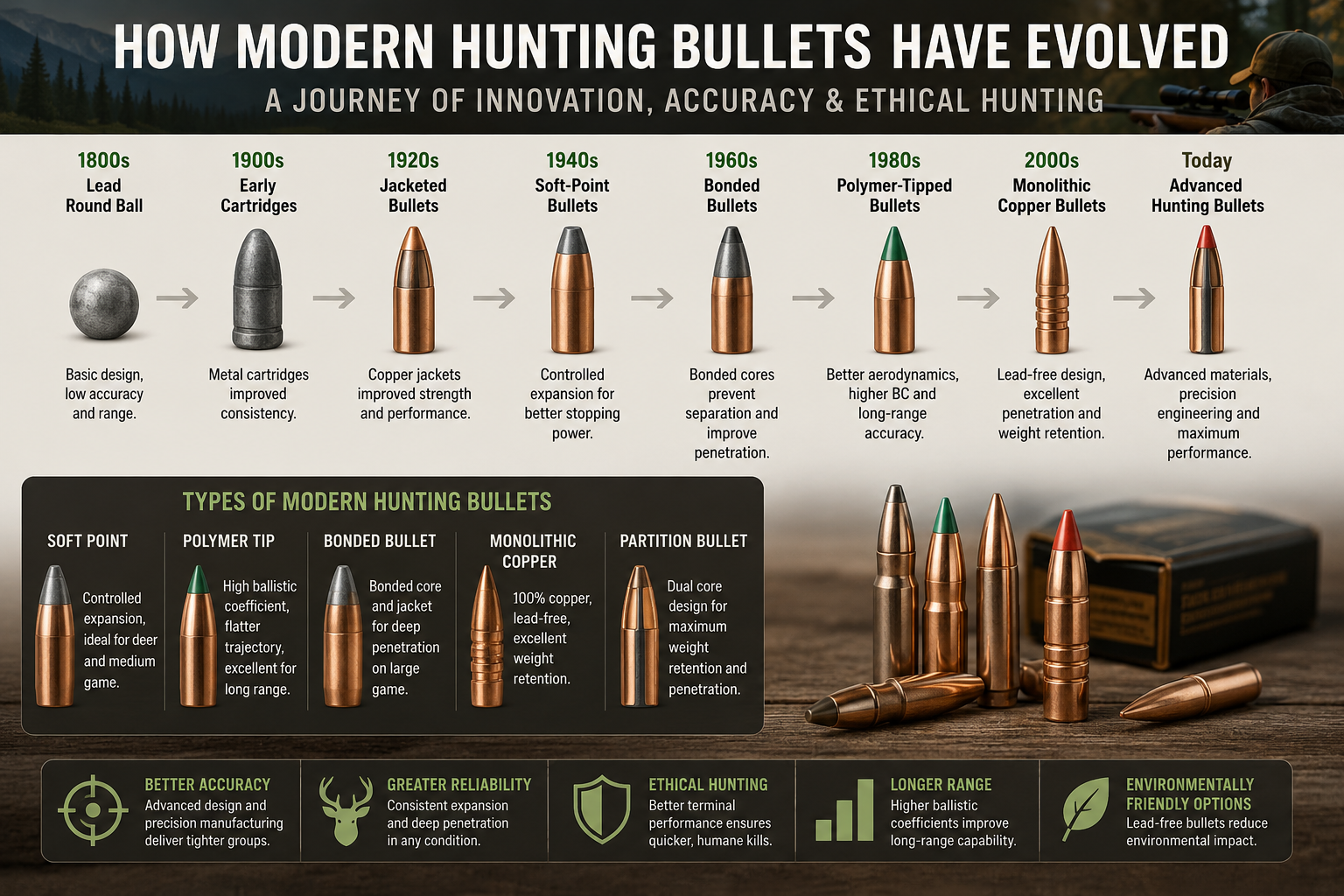
As firearms improved during the 19th century, bullet design also evolved. The invention of metallic cartridges allowed manufacturers to create bullets with better consistency and performance.
One of the biggest milestones came with jacketed bullets, where a soft lead core was enclosed inside a harder copper alloy jacket.
Read more about the history of ammunition here:
https://en.wikipedia.org/wiki/Bullet
Why Bullet Evolution Became Necessary
Hunters quickly realized that not every bullet behaved the same way after impact.
Some bullets expanded too quickly.
Others passed straight through an animal without transferring enough energy.
Some fragmented completely.
These issues encouraged manufacturers to improve bullet construction.
The goals became simple:
- Better accuracy
- Reliable expansion
- Deep penetration
- Humane harvesting
- Improved long-range performance
This demand sparked decades of innovation and completely changed the hunting industry.
The Birth of Jacketed Hunting Bullets
One of the most important chapters in How Modern Hunting Bullets Have Evolved was the introduction of full metal jacket (FMJ) and soft-point bullets.
While FMJ bullets became popular for military use, hunters preferred soft-point designs because they expanded upon impact.
Soft-point bullets feature an exposed lead tip surrounded by a copper jacket.
Advantages include:
- Controlled expansion
- Increased tissue damage
- Better energy transfer
- Reduced over-penetration
Learn more:
https://en.wikipedia.org/wiki/Soft-point_bullet
Expansion Technology Changed Everything
Expansion is what separates hunting bullets from target bullets.
Modern expanding bullets increase in diameter after impact.
This larger wound channel results in:
- Faster incapacitation
- Better blood trails
- Cleaner kills
- Reduced animal suffering
Manufacturers began experimenting with different nose designs, including:
- Hollow Point (HP)
- Polymer Tip
- Soft Point
- Bonded Core
- Partition Bullets
Each design solved different hunting challenges.
Bonded Bullets Revolutionized Big Game Hunting
One major breakthrough in How Modern Hunting Bullets Have Evolved came with bonded-core bullets.
Traditional bullets sometimes separated upon impact.
The lead core could detach from the copper jacket.
Bonded bullets chemically or mechanically fuse these components together.
Benefits include:
- Higher weight retention
- Deeper penetration
- Reliable expansion
- Better performance on larger animals
Popular examples include:
- Federal Trophy Bonded Tip
- Hornady InterBond
- Swift A-Frame
Official manufacturer resources:
Federal Premium:
https://www.federalpremium.com/
Hornady:
https://www.hornady.com/
Swift Bullets:
https://swiftbullets.com/
Polymer-Tipped Bullets Improved Accuracy
Hunters wanted bullets that flew farther without sacrificing expansion.
Manufacturers responded with polymer-tipped bullets.
Instead of exposed lead, these bullets use a plastic tip.
Benefits include:
- Higher ballistic coefficient
- Better aerodynamics
- Improved long-range accuracy
- Reliable expansion after impact
Some well-known examples are:
- Hornady SST
- Nosler Ballistic Tip
- Federal Terminal Ascent
Learn more:
Hornady SST
Nosler Ballistic Tip
Monolithic Copper Bullets Enter the Market
Environmental concerns regarding lead contamination encouraged the development of lead-free bullets.
Solid copper bullets became increasingly popular.
Unlike traditional lead-core bullets, these projectiles are made entirely from copper or copper alloys.
Advantages include:
- Nearly 100% weight retention
- Excellent penetration
- Consistent expansion
- Reduced environmental impact
Popular choices include:
- Barnes TTSX
- Hornady CX
- Federal Copper Trophy
Barnes Bullets:
https://www.barnesbullets.com/
Better Ballistic Coefficients Changed Long-Range Hunting
Modern hunters often shoot beyond 300 yards.
Older bullet designs lost velocity rapidly.
Today’s hunting bullets feature significantly improved ballistic coefficients (BC).
High-BC bullets:
- Resist wind drift
- Maintain velocity
- Retain more energy
- Produce flatter trajectories
This innovation has greatly improved long-range hunting ethics by increasing shot consistency.
Learn more about ballistic coefficient:
https://en.wikipedia.org/wiki/Ballistic_coefficient
Precision Manufacturing Improved Consistency
Modern ammunition manufacturing relies heavily on CNC machining, laser measurement, and computer-controlled quality inspection.
Compared to bullets produced fifty years ago, today’s bullets feature:
- Uniform jackets
- Consistent weight
- Perfect symmetry
- Better concentricity
These manufacturing improvements directly contribute to tighter shot groups.
Companies investing heavily in precision manufacturing include:
Sierra Bullets
https://www.sierrabullets.com/
Berger Bullets
Computer-Aided Bullet Design
One of the lesser-known developments in How Modern Hunting Bullets Have Evolved is the use of advanced computer modeling.
Engineers now simulate:
- Bullet flight
- Wind drift
- Impact expansion
- Penetration
- Material stress
Before a prototype is ever manufactured.
This greatly reduces development time while improving overall performance.
Specialized Bullets for Different Game
Today’s hunters no longer rely on a single bullet design.
Manufacturers create ammunition specifically for:
Deer Hunting
Fast expansion
Moderate penetration
Light recoil
Elk Hunting
Controlled expansion
Deep penetration
Higher retained weight
Dangerous Game
Maximum penetration
Solid construction
Reliable straight-line travel
Varmint Hunting
Rapid fragmentation
Minimal ricochet
Instant energy transfer
This specialization has dramatically increased hunting efficiency.
Lead-Free Regulations Influenced Innovation
Some states and countries have introduced restrictions on lead ammunition.
This accelerated research into alternative materials.
Copper bullets now perform remarkably well and continue improving each year.
Information about lead ammunition regulations:
National Shooting Sports Foundation
Terminal Ballistics Became a Science
Years ago, bullet testing relied mostly on field experience.
Today manufacturers use:
- Ballistic gelatin
- High-speed cameras
- Digital pressure sensors
- Computer simulations
These tools help engineers understand exactly how bullets behave after impact.
This scientific approach has dramatically improved hunting bullet performance.
Read about ballistic gelatin:
https://en.wikipedia.org/wiki/Ballistic_gelatin
Hunters Benefit from Better Bullet Choices
Modern hunters enjoy several advantages:
Higher Accuracy
Today’s bullets are manufactured to incredibly tight tolerances.
Greater Reliability
Expansion is more predictable than ever.
Ethical Harvesting
Improved terminal performance results in quicker, more humane kills.
Longer Effective Range
Better aerodynamics extend ethical shooting distances.
Less Meat Damage
Controlled-expansion bullets preserve more usable meat compared to older designs.
Future Trends in Hunting Bullet Technology
The future looks promising.
Manufacturers are researching:
- Hybrid bullet materials
- Improved polymer tips
- Environmentally friendly alloys
- Enhanced ballistic coatings
- Smart manufacturing techniques
- AI-assisted aerodynamic optimization
As technology advances, hunters can expect even greater accuracy and consistency.
Choosing the Right Modern Hunting Bullet
Understanding How Modern Hunting Bullets Have Evolved also helps hunters choose the right ammunition.
Consider:
Animal Size
Small deer require different bullets than moose or elk.
Shooting Distance
Long-range bullets should have higher ballistic coefficients.
Rifle Caliber
Always match the bullet weight to your rifle’s twist rate and intended use.
Hunting Environment
Dense forests may favor heavier bullets, while open terrain often rewards flatter-shooting projectiles.
Local Regulations
Some hunting areas require lead-free ammunition.
Always check your local wildlife regulations before hunting.
Conclusion
The story of How Modern Hunting Bullets Have Evolved is one of continuous innovation driven by the desire for greater accuracy, ethical hunting, and improved performance. From simple lead balls fired from early muskets to today’s advanced bonded, polymer-tipped, and monolithic copper bullets, every generation of ammunition has addressed the shortcomings of the last.
Modern hunters now benefit from decades of engineering, material science, and precision manufacturing. These advancements have made hunting safer, more humane, and more effective than ever before. Whether you’re pursuing whitetail deer in dense forests, elk across mountain ranges, or wild boar in rugged terrain, selecting the right bullet is just as important as choosing the right rifle.
As technology continues to evolve, hunting bullets will become even more efficient, environmentally friendly, and capable of delivering consistent terminal performance at greater distances. By understanding how modern hunting bullets have evolved, hunters can make smarter ammunition choices that improve both field performance and ethical hunting practices.
For more: click here