Workplace Rights: A Guide for U.S. Employees
Workplace Rights: A Guide for U.S. Employees
Introduction
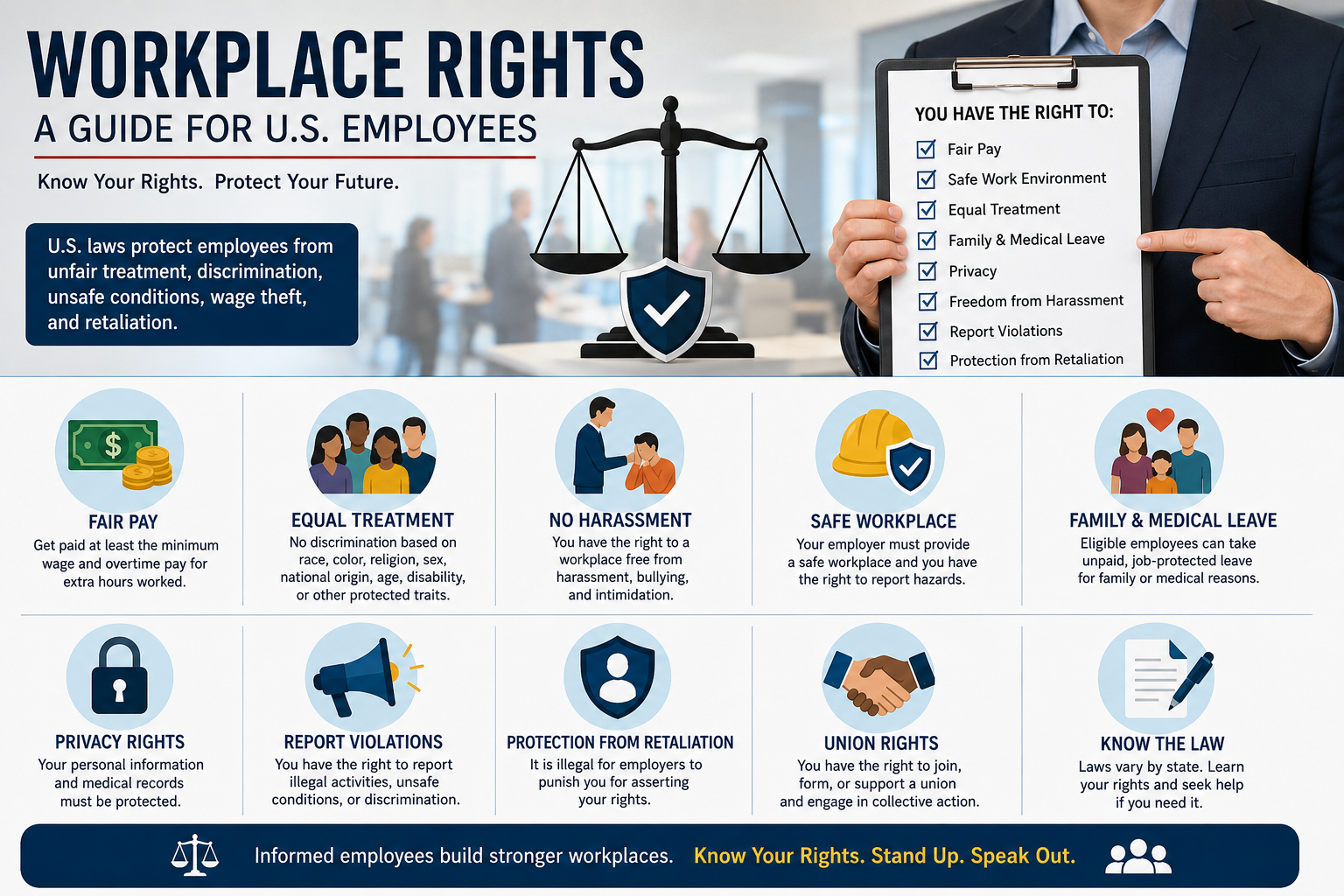
Every employee deserves to work in a safe, respectful, and fair environment. Understanding Workplace Rights is essential because these rights protect workers from unfair treatment, discrimination, wage theft, unsafe working conditions, and retaliation. Whether you are starting your first job or have years of professional experience, knowing your legal protections can help you make informed decisions and respond confidently if problems arise.
In the United States, workplace rights are protected through several federal and state laws enforced by government agencies such as the U.S. Department of Labor (DOL), the Equal Employment Opportunity Commission (EEOC), and the Occupational Safety and Health Administration (OSHA). These organizations ensure employers follow labor laws and provide employees with fair treatment.
This guide explains the most important Workplace Rights every U.S. employee should know, including fair pay, workplace safety, anti-discrimination protections, leave benefits, and what to do if your rights are violated.
What Are Workplace Rights?
Workplace Rights are legal protections that guarantee employees fair treatment while performing their jobs. These rights are designed to prevent employers from exploiting workers and to ensure a safe, healthy, and respectful work environment.
Some workplace rights are protected under federal law, while others may vary depending on the state where an employee works.
Official Source
U.S. Department of Labor
https://www.dol.gov/general/aboutdol/majorlaws
The Right to Fair Wages
One of the most important Workplace Rights is receiving fair compensation for work performed.
The Fair Labor Standards Act (FLSA) establishes rules regarding:
- Federal minimum wage
- Overtime pay
- Child labor protections
- Recordkeeping requirements
Most non-exempt employees must receive overtime pay equal to at least one and one-half times their regular hourly rate for hours worked over 40 in a workweek.
Although the federal minimum wage is currently $7.25 per hour, many states have adopted higher minimum wages. Employers must generally pay whichever minimum wage provides greater protection to employees.
Learn More
Fair Labor Standards Act (FLSA)
https://www.dol.gov/agencies/whd/flsa
Equal Employment Opportunity
Every employee has the right to equal treatment regardless of:
- Race
- Color
- Religion
- Sex
- Pregnancy
- National origin
- Disability
- Age (40 and older)
- Genetic information
Employers cannot make hiring, firing, promotion, salary, or training decisions based on these protected characteristics.
If discrimination occurs, employees may file a complaint with the Equal Employment Opportunity Commission (EEOC).
Official Resource
Equal Employment Opportunity Commission
Protection Against Workplace Harassment
Harassment is another serious violation of Workplace Rights.
Harassment becomes illegal when it creates a hostile work environment or affects employment decisions.
Examples include:
- Sexual harassment
- Racial slurs
- Offensive jokes
- Bullying based on protected characteristics
- Threats or intimidation
Employers are legally responsible for investigating complaints and taking corrective action when harassment occurs.
EEOC Guidance
https://www.eeoc.gov/harassment
Workplace Safety Rights
Employees should never have to choose between earning a paycheck and protecting their health.
The Occupational Safety and Health Administration (OSHA) requires employers to provide workplaces free from recognized hazards.
Employees have the right to:
- Receive safety training
- Report unsafe conditions
- Request OSHA inspections
- Access injury records
- Refuse dangerous work in limited situations
Employers cannot legally retaliate against employees who report workplace safety concerns.
OSHA Official Website
The Right to Report Safety Concerns
Many workers hesitate to report unsafe conditions because they fear losing their jobs.
Fortunately, federal law protects whistleblowers who report violations involving:
- Unsafe equipment
- Hazardous chemicals
- Unsafe construction practices
- Health hazards
- Illegal employer conduct
Retaliation may include:
- Firing
- Demotion
- Reduced hours
- Threats
- Harassment
Such retaliation is prohibited under several federal whistleblower protection laws.
OSHA Whistleblower Program
https://www.whistleblowers.gov/
Family and Medical Leave Rights
Many employees qualify for unpaid, job-protected leave under the Family and Medical Leave Act (FMLA).
Eligible workers may take up to 12 weeks of unpaid leave for reasons such as:
- Birth of a child
- Adoption
- Serious personal illness
- Caring for a spouse, child, or parent with a serious health condition
- Certain military family situations
After approved leave, employees generally have the right to return to the same or an equivalent position.
Learn More
Family and Medical Leave Act
https://www.dol.gov/agencies/whd/fmla
Employee Privacy Rights
Although employers may monitor certain workplace activities, employees still maintain important privacy protections.
Depending on federal and state laws, employers generally cannot unlawfully access:
- Medical records
- Personal information
- Protected communications
- Certain electronic data
Privacy rules often differ by state, making it important to understand local employment laws in addition to federal regulations.
More Information
Disability Rights in the Workplace
The Americans with Disabilities Act (ADA) protects qualified employees with disabilities.
Employers must provide reasonable accommodations unless doing so creates an undue hardship.
Examples include:
- Modified work schedules
- Accessible workstations
- Specialized equipment
- Remote work arrangements when appropriate
- Sign language interpreters
Employees cannot be fired or denied employment simply because they have a disability if they can perform the essential functions of the job with reasonable accommodation.
ADA Information
Protection Against Retaliation
Employees are legally protected when they exercise their Workplace Rights.
Employers cannot retaliate against workers for:
- Reporting discrimination
- Filing wage complaints
- Reporting safety violations
- Participating in investigations
- Requesting accommodations
- Taking protected medical leave
Retaliation is one of the most common employment law violations reported in the United States.
EEOC Retaliation Guidance
https://www.eeoc.gov/retaliation
Understanding Workplace Rights is not limited to knowing minimum-wage, discrimination, leave, and workplace-safety laws. Employees should also understand their rights concerning termination, workplace injuries, labor unions, wage theft, employment agreements, and government complaints.
The exact protection available to an employee may depend on federal law, state law, the size of the employer, the employee’s occupation, and whether the worker is classified as an employee or an independent contractor. For this reason, workers should review both federal and state requirements when handling a workplace dispute.
At-Will Employment and Employee Rights
Most employment relationships in the United States are generally treated as “at-will” unless an employment contract, collective bargaining agreement, public-sector rule, or state law provides otherwise.
At-will employment usually means that an employer can end the employment relationship at any time and that an employee can also leave the job at any time. However, at-will employment does not give an employer permission to terminate someone for an illegal reason.
An employer may not legally fire an employee because the worker:
- Reported unlawful discrimination or harassment
- Complained about unpaid wages
- Participated in a workplace investigation
- Reported unsafe working conditions
- Requested a legally protected accommodation
- Took qualifying family or medical leave
- Participated in protected union or collective activity
- Reported certain violations of law
Federal law does not require employers to provide an immediate final paycheck in every situation, but state laws may establish specific payment deadlines. Employees should therefore check their state labor department’s rules after resignation or termination.
Official information about termination is available from the U.S. Department of Labor.
What Is Wrongful Termination?
Wrongful termination occurs when an employee is dismissed for a reason that violates a law, enforceable contract, or recognized public policy.
A termination may be unlawful when it is based on discrimination involving race, color, religion, sex, pregnancy, national origin, age, disability, or another legally protected characteristic. It may also be unlawful when it is intended to punish an employee for exercising protected Workplace Rights.
However, not every unfair, unexpected, or poorly explained dismissal is legally considered wrongful termination. An employer may generally dismiss an at-will employee for poor performance, misconduct, attendance problems, restructuring, or another lawful business reason.
Employees who believe they were wrongfully terminated should preserve relevant evidence, including:
- Employment contracts
- Offer letters
- Performance evaluations
- Emails and text messages
- Disciplinary notices
- Pay records
- Names of witnesses
- Copies of workplace complaints
- A timeline of important events
Workers should avoid taking confidential business information that they are not legally entitled to possess. Evidence should be collected through lawful methods.
Workers’ Compensation Rights
Employees who suffer a job-related injury or occupational illness may qualify for workers’ compensation benefits. These benefits may include medical treatment, partial wage replacement, rehabilitation services, and disability payments.
Workers’ compensation programs for most private-sector and state employees are administered at the state level. The U.S. Department of Labor administers separate compensation programs for federal employees and certain specialized groups.
After a workplace injury, an employee should generally:
- Seek necessary medical attention.
- Report the injury to the employer promptly.
- Record when, where, and how the injury happened.
- Obtain the names of any witnesses.
- Keep medical reports, bills, and work restrictions.
- Follow the applicable workers’ compensation claim process.
Reporting deadlines and filing procedures vary by state. Delaying a report may make a claim more difficult.
Employees can locate the appropriate state agency through the Department of Labor’s State Workers’ Compensation Officials directory.
Federal employees can find claim information through the Federal Employees’ Compensation Program.
Workplace Rights Related to Labor Unions
The National Labor Relations Act protects many private-sector employees who act together to improve their wages and working conditions. Employees may have the right to:
- Form a union
- Join an existing union
- Assist a union
- Discuss union activity with coworkers
- Distribute union materials during appropriate nonworking times
- Sign union authorization cards
- Participate in collective bargaining
- Work together regarding pay, schedules, safety, or workplace policies
- Refuse to participate in union activity
Employers may not legally threaten, interrogate, spy on, or punish covered employees because they support lawful union activity. They also may not promise special benefits to discourage employees from organizing.
Employees do not necessarily need to belong to a formal union to engage in protected concerted activity. For example, multiple employees may be protected when they approach management together about wages, schedules, safety concerns, or workplace policies.
More information is available from the National Labor Relations Board, the federal agency responsible for protecting many private-sector employees’ organizing and collective-action rights.
Understanding Employment Contracts
An employment contract may define important terms such as:
- Salary and benefits
- Job responsibilities
- Length of employment
- Grounds for termination
- Confidentiality obligations
- Intellectual property ownership
- Dispute-resolution procedures
- Non-solicitation restrictions
- Severance benefits
- Bonus or commission requirements
Employees should carefully read a contract before signing it. Particular attention should be paid to arbitration clauses, repayment obligations, confidentiality terms, commission rules, and post-employment restrictions.
The enforceability of non-compete and similar agreements depends heavily on state law and the individual circumstances. Employees should not assume that a restriction is either automatically valid or automatically unenforceable.
When an agreement involves significant compensation, intellectual property, severance, or limits on future employment, obtaining advice from a qualified employment attorney may be appropriate.
Wage Theft and Unpaid Compensation
Wage theft occurs when an employee is not paid all compensation legally owed. It can appear in several forms, including:
- Failure to pay for all hours worked
- Unpaid overtime
- Paying less than the applicable minimum wage
- Requiring off-the-clock work
- Illegal deductions from wages
- Improperly withholding tips
- Incorrectly classifying an employee as exempt from overtime
- Misclassifying an employee as an independent contractor
Employees should independently track their hours, pay rates, breaks, commissions, tips, and deductions. Pay stubs, schedules, time records, emails, and bank deposits can help support a wage complaint.
The Wage and Hour Division states that workers are entitled to proper payment for covered work and all compensable hours.
A wage complaint can be submitted through the U.S. Department of Labor Wage and Hour Division. The agency explains that workers may contact its offices for assistance and that investigators may request payment of back wages when violations are found.
How to Report a Workplace Rights Violation
The correct complaint process depends on the type of violation.
Discrimination or Harassment
Employment discrimination complaints may be filed with the Equal Employment Opportunity Commission. In general, an EEOC charge must be submitted within 180 calendar days of the discriminatory act. That period may be extended to 300 days when a state or local agency enforces a law prohibiting the same type of discrimination. Different rules may apply to certain claims, so employees should act promptly.
Employees can begin through the EEOC’s Charge of Employment Discrimination information page.
Wage or Leave Violations
Complaints involving minimum wage, overtime, certain medical-leave rights, or related retaliation may be reported to the Wage and Hour Division.
Workplace Safety
Unsafe conditions and certain safety-related retaliation complaints may be reported to the Occupational Safety and Health Administration.
Union or Collective-Action Violations
Employees who believe their organizing or collective-action rights were violated can contact the National Labor Relations Board.
State-Law Violations
State labor departments and state civil-rights agencies may offer protections beyond federal law. These can include higher minimum wages, paid sick leave, meal-break rules, broader anti-discrimination coverage, and additional family-leave rights.
Steps to Take Before Filing a Complaint
Before filing a formal complaint, an employee should consider taking the following steps:
- Write a factual timeline of what happened.
- Preserve relevant lawful evidence.
- Review workplace policies and complaint procedures.
- Report the matter internally when safe and appropriate.
- Record the date, method, and recipient of each complaint.
- Avoid deleting messages or altering documents.
- Check the filing deadline immediately.
- Contact the correct federal or state agency.
- Consider legal advice for serious or complex disputes.
Employees should not delay action while waiting for an internal investigation if an external filing deadline is approaching.
Frequently Asked Questions About Workplace Rights
Can my employer punish me for discussing my wages?
Many private-sector employees have the right to discuss wages and working conditions with coworkers as part of protected collective activity. However, coverage and exceptions can depend on the employee’s role and workplace.
Can I be fired after filing a complaint?
An employer may still take action for a legitimate, non-retaliatory reason. However, an employer generally cannot punish an employee because the worker filed a protected complaint, cooperated in an investigation, or exercised a legal right. The Department of Labor confirms that retaliation is prohibited under laws enforced by its Wage and Hour Division.
Does an employer have to give a warning before termination?
Federal law does not generally require a warning before an individual termination. A contract, union agreement, workplace policy, or state law may provide additional protections. Large layoffs or plant closings may also be subject to the Worker Adjustment and Retraining Notification Act when its requirements are met.
Can an employer classify any worker as an independent contractor?
No. Worker classification depends on the actual working relationship and the legal test applied under the relevant law. A written agreement calling someone an independent contractor does not automatically settle the issue.
Are workplace complaints confidential?
Government agencies may protect information to the extent allowed by law, but complete confidentiality cannot always be guaranteed. An employer may need to know enough information to respond to or investigate the allegation.
Do undocumented employees have Workplace Rights?
Many federal and state workplace protections apply regardless of immigration status, although available remedies may differ. Workers should obtain guidance from the appropriate agency or a qualified attorney for their circumstances.
Final Conclusion
Knowing your Workplace Rights allows you to recognize unlawful behavior, preserve important evidence, and seek assistance before filing deadlines expire. U.S. employees may be protected against discrimination, harassment, retaliation, wage theft, unsafe conditions, unlawful interference with collective activity, and certain forms of wrongful termination.
Workers should remember that federal law provides a minimum level of protection, while state and local laws may offer broader rights. Because every employment situation is different, employees facing serious workplace disputes should consult the relevant government agency or a qualified employment-law professional.
This guide provides general educational information and is not a substitute for legal advice.
For more: click here