Constitutional Rights in the United States
Constitutional Rights in the United States
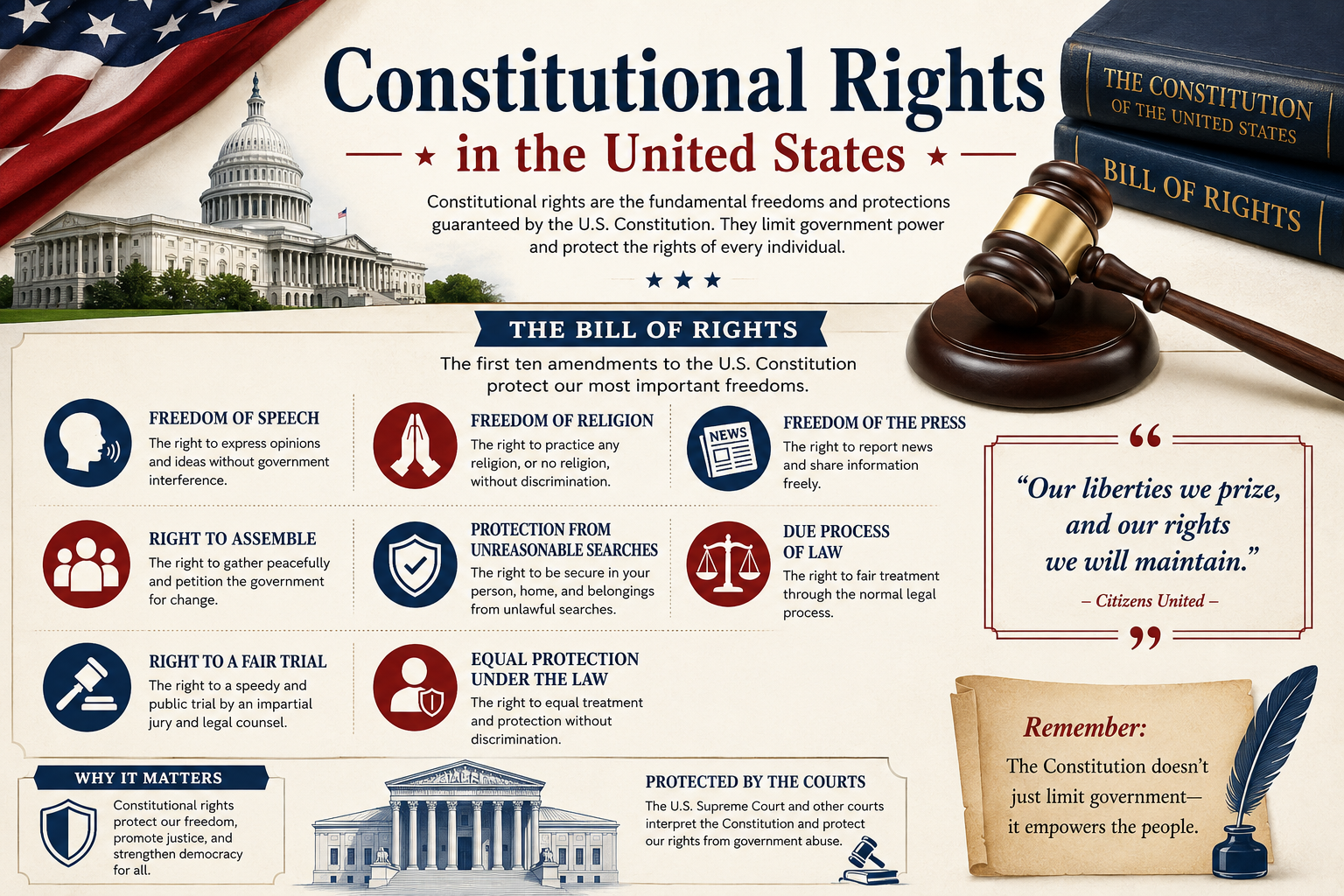
Constitutional rights are the foundation of freedom and democracy in the United States. They protect individuals from unfair government interference and give people the freedom to express their opinions, follow their religion, receive fair treatment, and participate in public life. Although many Americans hear about these rights in school, court cases, political discussions, or the news, understanding how they work in everyday life is equally important.
The United States Constitution does more than describe the structure of the federal government. It establishes limits on governmental power and protects important individual freedoms. Some protections appear in the original Constitution, while many of the best-known constitutional rights are found in its amendments, particularly the Bill of Rights.
The official text and legal explanations of the Constitution can be studied through the Constitution Annotated provided by Congress. This resource explains how different constitutional provisions have been interpreted by the courts over time.
What Are Constitutional Rights?
Constitutional rights are freedoms and legal protections guaranteed by the United States Constitution. These rights mainly protect people against improper actions by federal, state, and local governments.
For example, the government generally cannot punish someone simply because that person criticizes a political leader. Law-enforcement officers must follow constitutional rules when searching a person’s home. Courts must provide basic legal protections before the government can take away someone’s life, liberty, or property.
In simple terms, constitutional rights help answer an important question: What is the government allowed to do, and where must its power stop?
These rights include freedom of speech, freedom of religion, freedom of the press, the right to peacefully assemble, protection against unreasonable searches, due process of law, the right to legal counsel in criminal cases, and equal protection under the law.
However, constitutional rights are not always unlimited. Courts often have to balance individual liberty against public safety, national security, privacy, and the rights of other people. This is why constitutional law can sometimes be complicated. The wording of the Constitution may be brief, but its application can depend on the facts of a particular situation.
The Constitution Annotated explains that individual rights are an important part of constitutional law because the Constitution both limits government power and expressly protects certain liberties from government interference.
A Brief History of Constitutional Rights in the United States
The United States Constitution was written in 1787 during the Constitutional Convention in Philadelphia. It was created because the country’s earlier governing system, established under the Articles of Confederation, had produced a weak national government that struggled to handle major political and economic problems.
The Constitution created a stronger federal system with three separate branches:
- The legislative branch, which makes laws
- The executive branch, which enforces laws
- The judicial branch, which interprets laws
This separation of powers was designed to prevent too much authority from being concentrated in one person or institution.
However, many people were concerned that the original Constitution did not clearly list enough protections for individual liberty. During the debate over ratification, critics argued that a strong national government might eventually abuse its power. Supporters of a bill of rights believed that certain freedoms should be clearly written into the country’s highest law.
In response to these concerns, the First Congress proposed 12 constitutional amendments in 1789. Ten of them were approved by the required number of states and became effective on December 15, 1791. These first ten amendments are known as the Bill of Rights.
Readers can view the original document, its transcript, and historical background on the National Archives Bill of Rights page.
What Is the Bill of Rights?
The Bill of Rights consists of the first ten amendments to the United States Constitution. It protects important civil liberties and establishes rules that the government must follow when dealing with individuals.
According to the National Archives, the Bill of Rights defines Americans’ rights in relation to their government. It protects freedoms such as speech, religion, and the press, while also establishing legal protections related to criminal proceedings and due process.
Each amendment deals with a different area of liberty or governmental authority:
First Amendment
The First Amendment protects freedom of religion, speech, the press, peaceful assembly, and the right to petition the government.
Second Amendment
The Second Amendment addresses the right of the people to keep and bear arms.
Third Amendment
The Third Amendment restricts the government from forcing people to house soldiers in their homes during peacetime without their consent.
Fourth Amendment
The Fourth Amendment protects people against unreasonable government searches and seizures.
Fifth Amendment
The Fifth Amendment includes several legal protections, including due process, protection against self-incrimination, and protection against being tried twice for the same offense under certain circumstances.
Sixth Amendment
The Sixth Amendment protects the rights of people accused of crimes. These protections include the right to a speedy and public trial, an impartial jury, information about the charges, and assistance from legal counsel.
Seventh Amendment
The Seventh Amendment protects the right to a jury trial in certain federal civil cases.
Eighth Amendment
The Eighth Amendment prohibits excessive bail, excessive fines, and cruel and unusual punishment.
Ninth Amendment
The Ninth Amendment explains that the listing of certain rights in the Constitution does not mean that people have no other rights.
Tenth Amendment
The Tenth Amendment states that powers not given to the federal government, and not prohibited to the states, are reserved to the states or the people.
The complete wording of these amendments is available through the official Bill of Rights transcript.
Freedom of Speech
Freedom of speech is one of the most widely recognized constitutional rights in the United States. It allows people to share opinions, criticize government policies, discuss social issues, support political candidates, and participate in public debate without unnecessary government censorship.
The First Amendment states that Congress may not pass a law that abridges freedom of speech or freedom of the press. It also protects religious liberty, peaceful assembly, and petitions for government action. The official wording and legal analysis can be found on the First Amendment page of Constitution Annotated.
Freedom of speech is especially important in a democracy because voters need the ability to discuss political leaders and government decisions openly. Journalists need the freedom to investigate public officials. Activists need the ability to raise awareness about injustice, and ordinary citizens need space to express disagreement.
However, freedom of speech does not mean that every form of expression is protected in every situation. The government may regulate certain narrowly defined categories of speech, and reasonable rules may apply to the time, place, and manner of public demonstrations.
For example, a city may require permits for large marches to manage traffic and public safety. Such a rule may be lawful when it applies fairly and is not being used to silence a particular political viewpoint.
This distinction is important: the Constitution strongly protects unpopular opinions, but it does not automatically remove responsibility for conduct that violates valid laws or directly harms others.
Freedom of Religion
Freedom of religion is another central part of the First Amendment. It includes two related protections: the Establishment Clause and the Free Exercise Clause.
The Establishment Clause prevents the government from establishing an official religion or improperly promoting one religion over another. The Free Exercise Clause protects a person’s ability to practice a religion according to personal belief.
Together, these protections support religious diversity. A person may follow Christianity, Islam, Judaism, Hinduism, Buddhism, another faith, or no religion at all. Government authorities generally cannot force people to accept a particular religious belief.
Religious freedom does not always settle every dispute automatically. Conflicts can occur when religious practices interact with employment rules, education policies, healthcare requirements, public services, or anti-discrimination laws. Courts may then examine whether the government has placed an unconstitutional burden on religious exercise or treated certain religious groups unfairly.
Freedom of the Press
Freedom of the press protects the ability of journalists, publishers, broadcasters, and other media organizations to gather and publish information without improper government control.
A free press can investigate corruption, report misconduct, question public officials, and help citizens understand what their government is doing. Without this protection, leaders could attempt to hide mistakes by censoring unfavorable reporting.
Modern freedom-of-the-press questions are not limited to newspapers and television channels. Independent journalists, online publications, podcasts, bloggers, and digital news platforms can also play important roles in public discussion.
At the same time, freedom of the press does not create permission to break every law or publish information without possible legal consequences. Issues involving defamation, privacy, confidential information, national security, and access to government records can create difficult legal questions.
The Right to Peaceful Assembly and Petition
The First Amendment also protects the right of people to gather peacefully and ask the government to address their concerns.
This protection allows individuals to organize protests, attend political meetings, join advocacy groups, participate in public demonstrations, and deliver petitions to government officials. Many major movements in American history—including campaigns for civil rights, voting rights, workers’ rights, and women’s equality—depended on the ability of people to organize publicly.
The word “peacefully” is important. The Constitution protects peaceful demonstrations, but it does not generally protect violence, vandalism, or serious threats against others. Government authorities may enforce neutral public-safety rules, but they cannot lawfully target a demonstration merely because they dislike its message.
Why Constitutional Rights Matter
Constitutional rights matter because government power can deeply affect a person’s freedom, property, privacy, reputation, and future. Written protections create standards that public officials are expected to follow.
These rights also give individuals a legal basis for challenging unconstitutional government actions. A person who believes that a government agency has violated the Constitution may sometimes bring a case before a court. Judges then examine the law, the government’s actions, previous court decisions, and the relevant constitutional provision.
The United States Supreme Court has a major role in constitutional interpretation. It is the country’s highest court for cases arising under the Constitution and federal law. More information about that role is available on the Supreme Court’s constitutional interpretation page.
Constitutional rights are therefore more than historical promises written on old paper. They continue to influence schools, workplaces, police departments, courtrooms, elections, public protests, online communication, and everyday interactions between people and their government.
Protection Against Unreasonable Searches and Seizures
One of the most important constitutional rights in the United States is the protection against unreasonable searches and seizures. This protection comes from the Fourth Amendment, which helps safeguard people’s privacy from unnecessary government intrusion.
The Fourth Amendment generally requires law enforcement officers to obtain a warrant based on probable cause before searching someone’s home, vehicle, or personal belongings. A warrant must usually be approved by a judge and describe the place to be searched and the items to be seized.
The official text and legal interpretation of the Fourth Amendment can be found on the Constitution Annotated website:
https://constitution.congress.gov/constitution/amendment-4/
Although warrants are common, there are several well-established exceptions recognized by the courts. For example, police officers may conduct certain searches when someone voluntarily gives consent, when evidence is in plain view, or during specific emergency situations. These exceptions have developed through decades of Supreme Court decisions.
Modern technology has made Fourth Amendment issues even more complicated. Courts now regularly consider questions involving smartphones, cloud storage, GPS tracking, surveillance cameras, facial recognition software, and digital communications. As technology evolves, constitutional rights continue adapting through judicial interpretation.
Due Process of Law
Another essential constitutional right is the guarantee of due process, which is protected by both the Fifth and Fourteenth Amendments.
Due process means that the government cannot deprive a person of life, liberty, or property without following fair legal procedures. In simple terms, the government must obey the law before taking action against an individual.
Due process includes several important protections:
- The right to receive notice of legal proceedings.
- The opportunity to present evidence.
- The ability to defend yourself.
- A fair hearing before an impartial decision-maker.
- Equal application of legal procedures.
There are generally two forms of due process:
Procedural Due Process
Procedural due process focuses on how the government acts. It requires fair procedures before someone loses important rights or property.
For example, if a government agency wants to revoke a professional license, it generally cannot do so without giving the individual notice and an opportunity to respond.
Substantive Due Process
Substantive due process focuses on what the government is allowed to regulate. Courts sometimes use this doctrine to determine whether certain laws improperly interfere with fundamental constitutional rights.
Because substantive due process involves complex constitutional questions, it remains one of the most debated areas of American constitutional law.
The Right to a Fair Trial
The Sixth Amendment guarantees several constitutional rights for people accused of crimes.
These protections help ensure that criminal prosecutions remain fair rather than arbitrary.
Important trial rights include:
Right to a Speedy Trial
Criminal cases should not remain unresolved indefinitely. An unnecessary delay can make it harder for defendants to gather evidence or locate witnesses.
Right to a Public Trial
Court proceedings are generally open to the public. Transparency helps maintain confidence in the justice system.
Right to an Impartial Jury
Defendants usually have the right to be judged by an unbiased jury selected according to legal procedures.
Right to Know the Charges
Every defendant has the right to understand exactly what criminal charges have been filed.
Right to Confront Witnesses
The accused generally has the opportunity to question witnesses who testify against them.
Right to Legal Counsel
Perhaps one of the most significant constitutional rights is the right to assistance from an attorney. If a criminal defendant cannot afford legal representation in qualifying cases, the court may appoint a lawyer.
These protections are essential because they reduce the risk of wrongful convictions and help preserve public confidence in the legal system.
Equal Protection Under the Law
The Equal Protection Clause of the Fourteenth Amendment requires states to treat people equally under the law.
This does not mean every law must affect every person in exactly the same way. Instead, it generally means that governments must have legitimate legal reasons when treating groups differently.
Equal protection has played an important role in many areas of American history, including:
- Racial equality
- Voting rights
- Public education
- Marriage rights
- Gender discrimination
- Disability rights
Many landmark Supreme Court decisions have relied on the Equal Protection Clause when determining whether certain laws violated constitutional rights.
Official information about the Fourteenth Amendment is available here:
https://constitution.congress.gov/constitution/amendment-14/
Important Supreme Court Cases That Shaped Constitutional Rights
Throughout American history, the Supreme Court has interpreted constitutional rights in ways that continue to influence everyday life.
Marbury v. Madison (1803)
This landmark decision established the principle of judicial review, allowing courts to declare laws unconstitutional.
Without judicial review, courts would have much less authority to protect constitutional rights.
Brown v. Board of Education (1954)
This historic case declared racial segregation in public schools unconstitutional.
The decision became one of the most influential civil rights rulings in American history and significantly advanced equal protection under the law.
Miranda v. Arizona (1966)
This famous decision requires police officers to inform suspects of certain constitutional rights before custodial interrogation.
These warnings include:
- The right to remain silent.
- The right to an attorney.
- Notice that statements may be used in court.
Today, these protections are commonly known as Miranda Rights.
Gideon v. Wainwright (1963)
This case strengthened the Sixth Amendment by confirming that defendants who cannot afford lawyers are entitled to legal representation in serious criminal cases.
New York Times Co. v. United States (1971)
Sometimes called the Pentagon Papers Case, this decision reinforced freedom of the press by limiting the government’s ability to prevent publication of certain information.
Additional Supreme Court opinions and case information can be found at:
https://www.supremecourt.gov/
Modern Challenges to Constitutional Rights
Although constitutional rights have existed for centuries, new challenges continue to emerge.
Digital Privacy
Smartphones contain enormous amounts of personal information.
Questions about phone searches, encrypted communications, cloud storage, artificial intelligence, and government surveillance continue reaching the courts.
Social Media
Online platforms have changed how people communicate.
Legal discussions continue regarding free speech, misinformation, content moderation, and the relationship between private technology companies and constitutional protections.
National Security
Governments sometimes expand surveillance or emergency powers during national security crises.
Courts often examine whether these actions properly balance public safety with individual constitutional rights.
Artificial Intelligence
AI technology raises new legal questions involving privacy, discrimination, automated decision-making, facial recognition, and data collection.
As technology continues advancing, judges will likely interpret constitutional rights in situations that the Constitution’s authors could never have imagined.
Why Understanding Constitutional Rights Is Important
Every American benefits from understanding constitutional rights.
Knowledge of these protections helps people:
- Protect their legal freedoms.
- Participate responsibly in democracy.
- Understand court decisions.
- Recognize government limits.
- Exercise civil liberties confidently.
- Respect the rights of others.
Constitutional rights are not only important during criminal cases. They affect education, employment, religious practice, political participation, public demonstrations, journalism, privacy, and everyday interactions with government agencies.
Frequently Asked Questions
What are constitutional rights?
Constitutional rights are freedoms and legal protections guaranteed by the United States Constitution that limit government power and protect individual liberty.
Where are most constitutional rights found?
Many of the best-known constitutional rights appear in the Bill of Rights, which consists of the first ten amendments to the Constitution.
Can constitutional rights ever be limited?
Yes. Some constitutional rights may be subject to reasonable legal restrictions depending on the circumstances. Courts determine whether those restrictions are consistent with the Constitution.
Who protects constitutional rights?
Federal and state courts, especially the United States Supreme Court, play a central role in interpreting and protecting constitutional rights.
Why are constitutional rights important?
They preserve individual freedom, prevent government abuse, support democracy, protect fairness in the legal system, and ensure equal treatment under the law.
Conclusion
Constitutional rights remain one of the strongest foundations of American democracy. They protect freedom of speech, religion, the press, privacy, due process, equal protection, and many other essential liberties that affect millions of people every day.
Although the Constitution was written more than two centuries ago, its principles continue to guide the nation through changing social, political, and technological challenges. Courts regularly interpret these protections to address new issues while remaining faithful to the Constitution’s core purpose of limiting government power and preserving individual freedom.
Understanding constitutional rights is not only valuable for lawyers or judges—it benefits every citizen. An informed public is better equipped to defend liberty, participate in democratic government, and respect the rights of others. As society continues to evolve, constitutional rights will remain central to maintaining justice, equality, and the rule of law in the United States.
For more: click here