The Science of Bullet Performance: What Really?
The Science of Bullet Performance: What Really?
Introduction
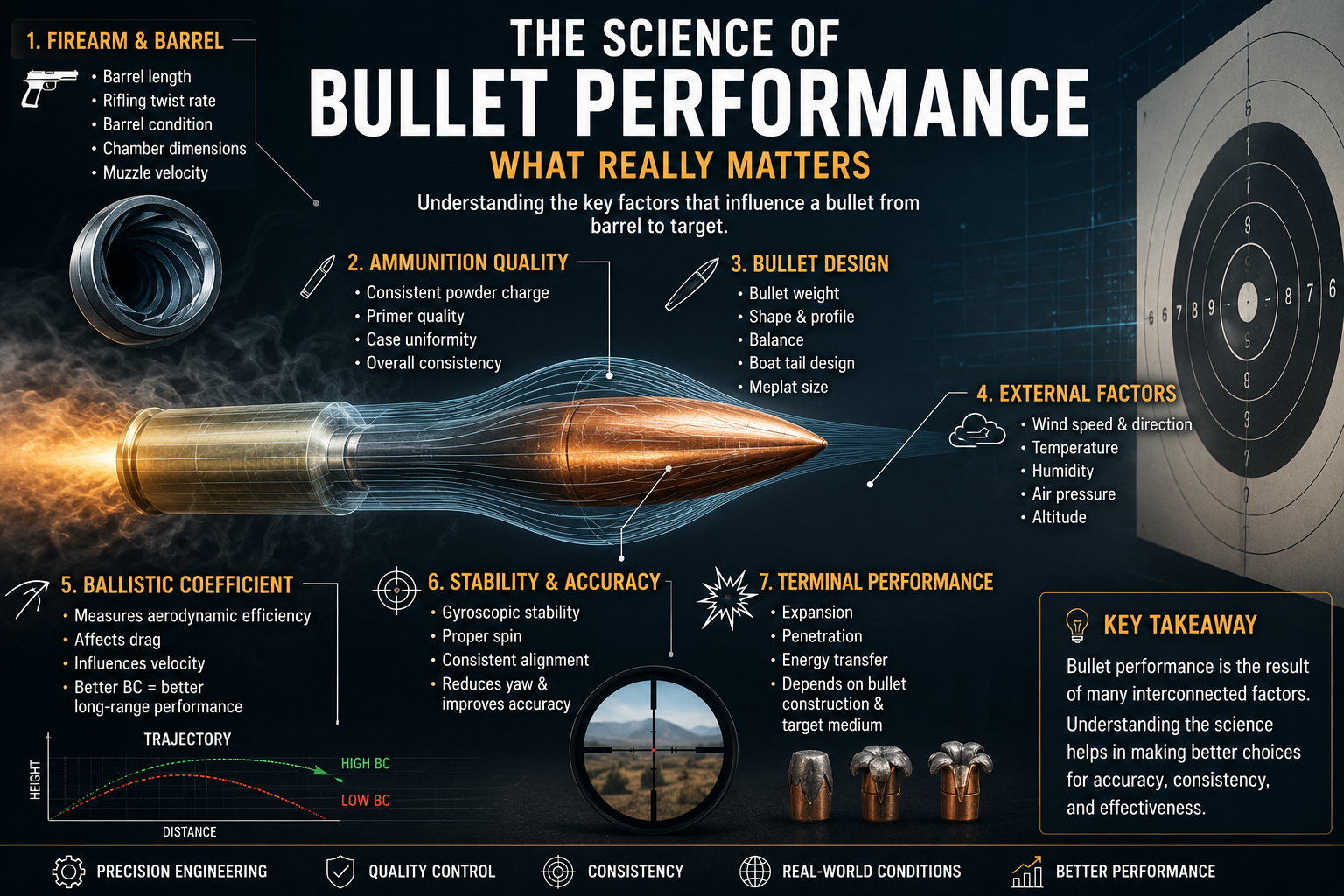
Understanding The Science of Bullet Performance is about much more than what happens after a trigger is pulled. It is a fascinating combination of physics, engineering, materials science, manufacturing precision, and environmental conditions. Every bullet is the result of years of research, careful design, and rigorous testing to ensure consistent behavior under controlled conditions.
Many people assume that bullet performance depends on a single factor, such as speed or caliber. In reality, it is influenced by a complex interaction of variables that affect how a projectile behaves from the moment it leaves the barrel until it reaches its intended destination. Scientists, engineers, manufacturers, forensic experts, and competitive researchers all study these principles for different purposes, including product development, quality assurance, safety, and accident investigation.
Whether you’re interested in engineering, physics, manufacturing, or forensic science, learning about The Science of Bullet Performance provides valuable insight into how modern technology and scientific principles work together. This article explores the major factors that influence bullet performance in a general educational context while explaining why consistency, quality, and environmental conditions all play important roles.
What Is Bullet Performance?
Bullet performance refers to the overall behavior and characteristics of a projectile throughout its flight. Rather than focusing on one measurement, performance includes several interconnected aspects such as stability, consistency, manufacturing quality, material properties, and environmental influences.
Scientists evaluate bullet performance because consistent results are essential in many professional fields, including product testing, forensic investigations, laboratory research, and sporting applications.
Understanding The Science of Bullet Performance begins with recognizing that no single characteristic determines overall performance. Instead, multiple scientific factors interact simultaneously.
The Physics Behind Bullet Motion
At its core, bullet performance is governed by the same physical laws that affect every moving object.
Once a projectile is in motion, it is influenced by several forces, including gravity and air resistance. Gravity continually pulls the projectile downward, while the surrounding air creates drag that slows it over time.
The study of projectile motion combines concepts from mechanics, aerodynamics, and fluid dynamics. Engineers use mathematical models and controlled testing to understand how these forces interact under different conditions.
These principles make The Science of Bullet Performance an interesting topic not only for firearms specialists but also for physics students and mechanical engineers.
The Importance of Manufacturing Precision
Modern manufacturing technology plays a major role in performance consistency.
Every projectile must meet strict quality standards regarding dimensions, weight, material composition, and surface finish. Even tiny variations can affect consistency during laboratory testing.
Manufacturers rely on:
- Precision machining
- Automated inspection systems
- Material testing
- Quality control procedures
- Statistical analysis
These processes help ensure that each production batch meets established specifications.
High manufacturing standards are one reason why The Science of Bullet Performance continues evolving alongside advances in engineering and industrial technology.
Materials Used in Bullet Construction
Material science has significantly influenced projectile development over the years.
Different materials are selected for reasons such as durability, manufacturability, corrosion resistance, and consistency.
Common materials include:
- Copper alloys
- Lead alloys
- Steel components in certain applications
- Polymer elements in specialized designs
Researchers continually study new materials that may improve manufacturing consistency while reducing environmental impact.
Material selection represents one of the most important aspects of The Science of Bullet Performance because physical properties directly influence behavior during testing.
Aerodynamics and Flight Stability
Aerodynamics is the study of how objects move through air.
Every projectile encounters air resistance, which affects its speed and stability during flight.
Engineers carefully evaluate aerodynamic characteristics using computer simulations and controlled experiments.
Important aerodynamic considerations include:
- Overall shape
- Surface smoothness
- Airflow behavior
- Balance
- Stability
Although aerodynamics influences performance, it works alongside many other scientific variables rather than acting alone.
Environmental Conditions Matter
Environmental factors can influence projectile behavior under controlled testing conditions.
These include:
Temperature
Extreme temperatures may slightly influence material behavior and testing conditions.
Humidity
Moisture in the atmosphere changes air density, although its effects are generally smaller than those of temperature or altitude.
Wind
Moving air alters the path of many airborne objects, including projectiles, making it an important consideration during scientific testing.
Altitude
Air density decreases at higher elevations, changing aerodynamic conditions.
Understanding how environmental variables interact is an essential part of The Science of Bullet Performance.
Consistency Is More Important Than Extremes
One of the biggest misconceptions is that maximum speed automatically means better performance.
In engineering and laboratory testing, consistency often matters more than peak measurements.
Reliable manufacturing produces predictable results across repeated tests.
Researchers therefore focus on repeatability rather than isolated outcomes.
This emphasis on consistency is central to The Science of Bullet Performance because dependable measurements provide better scientific data.
Quality Control in Modern Manufacturing
Manufacturers employ extensive quality-control systems before products reach consumers.
These systems include:
- Dimensional inspection
- Material verification
- Automated imaging
- Statistical sampling
- Batch testing
- Process monitoring
Quality assurance helps reduce manufacturing variation while improving reliability.
Laboratory Testing Methods
Scientific evaluation takes place under carefully controlled conditions.
Researchers may use:
- High-speed cameras
- Precision measuring instruments
- Environmental monitoring
- Digital recording systems
- Computer modeling
These tools allow scientists to study projectile behavior objectively while collecting accurate data.
Controlled testing is one reason The Science of Bullet Performance continues advancing through research and innovation.
The Role of Engineering Design
Every engineered product reflects a series of design decisions.
Engineers consider:
- Manufacturing efficiency
- Material selection
- Durability
- Cost
- Consistency
- Regulatory standards
Balancing these priorities requires extensive research, testing, and refinement.
Engineering improvements often result from years of experimentation rather than sudden breakthroughs.
Why Standardization Is Important
Industry standards help manufacturers maintain consistent product quality.
Standardization benefits:
- Researchers
- Manufacturers
- Testing laboratories
- Regulatory agencies
- Consumers
Consistent standards improve reliability while making scientific comparisons more meaningful.
Common Myths About Bullet Performance
Many misconceptions exist because movies and television often exaggerate real-world behavior.
Myth 1: Speed Determines Everything
Performance depends on numerous scientific variables rather than a single measurement.
Myth 2: Bigger Always Means Better
Different applications require different engineering priorities.
Myth 3: Every Projectile Behaves Identically
Manufacturing tolerances and environmental conditions always introduce some variation.
Separating myths from scientific reality helps people better understand The Science of Bullet Performance.
Advances in Technology
Technology continues transforming modern manufacturing and testing.
Recent developments include:
- Computer-aided engineering
- Advanced materials research
- Automated inspection
- Precision manufacturing
- Digital simulations
- Artificial intelligence for quality control
These innovations improve consistency while supporting ongoing scientific research.
Environmental Considerations
Manufacturers increasingly focus on sustainability.
Current research explores:
- Cleaner manufacturing processes
- Alternative materials
- Reduced waste
- Recycling initiatives
- Improved production efficiency
Environmental responsibility has become an important part of product development across many industries.
Applications Beyond Manufacturing
Knowledge about projectile science supports several professional fields.
Examples include:
- Mechanical engineering
- Materials science
- Physics education
- Industrial manufacturing
- Forensic science
- Safety testing
Each field applies scientific principles for different purposes while relying on accurate data and careful analysis.
The Importance of Scientific Research
Research never stops.
Scientists continue studying:
- Material behavior
- Aerodynamics
- Manufacturing techniques
- Measurement technology
- Environmental effects
Every improvement contributes to greater understanding while helping engineers design safer, more consistent products.
The continued evolution of The Science of Bullet Performance reflects the broader progress of science and engineering as a whole.
Looking Ahead
Future research will likely focus on:
- Smarter manufacturing systems
- Artificial intelligence in quality control
- Improved simulation software
- Advanced material development
- Greater sustainability
- Enhanced measurement accuracy
As technology evolves, researchers will gain an even deeper understanding of how different variables interact.
Conclusion
The Science of Bullet Performance is a multidisciplinary subject that combines physics, engineering, material science, aerodynamics, manufacturing, and quality assurance. Rather than depending on a single characteristic, projectile behavior results from the interaction of many carefully controlled variables. From material selection and precision manufacturing to environmental conditions and laboratory testing, every stage contributes to consistent and measurable performance.
Beyond its relevance to manufacturing and research, this topic also demonstrates how scientific principles apply to real-world engineering challenges. Advances in technology continue improving testing methods, production quality, and sustainability, ensuring that our understanding of The Science of Bullet Performance evolves alongside modern science. By viewing the subject through an educational and scientific lens, readers can appreciate the complexity behind product design, precision engineering, and the ongoing pursuit of accuracy, reliability, and innovation.
For more: click here