How Wind Affects Bullet Hunting Accuracy
How Wind Affects Bullet Hunting Accuracy
How Wind Affects Bullet Hunting Accuracy, Hunting is a skill that combines patience, preparation, and precision. Every experienced hunter knows that success depends on much more than choosing the right firearm or finding the perfect location. Among all the natural elements that influence a shot, wind is one of the most unpredictable and challenging factors. Even a gentle breeze can change the direction of a bullet, causing a perfectly aimed shot to miss the target.
Whether you are a beginner learning the basics or a seasoned hunter improving your long-range shooting skills, understanding how wind affects bullet performance is essential. Many hunters spend hours practicing at the shooting range under calm conditions, only to discover that real hunting situations present completely different challenges. Forests, open fields, hills, and valleys all create unique wind patterns that can dramatically affect accuracy.
For anyone interested in Bullet hunting, mastering wind reading is just as important as selecting the right ammunition or maintaining proper shooting posture. Learning to recognize wind speed, direction, and environmental conditions can greatly increase your chances of making clean, ethical shots while reducing the risk of injuring an animal.
In this guide, we’ll explore how wind influences hunting accuracy, why bullets drift off course, and the practical techniques hunters use to compensate for changing wind conditions.
Understanding Wind and Bullet Flight
The moment a bullet leaves the barrel, it begins interacting with the surrounding air. While gravity immediately starts pulling the bullet downward, wind pushes it sideways depending on its direction and strength.
Unlike stationary targets at a shooting range, wildlife is often found in environments where wind constantly changes. A bullet traveling hundreds of yards remains exposed to these moving air currents for a longer period, increasing the amount of drift before reaching the target.
Imagine throwing a baseball on a calm day. It travels almost exactly where you intend. Now imagine throwing the same baseball during a windy afternoon. The wind pushes it away from its original path. Bullets experience a similar effect, although at much higher speeds.
The farther the bullet travels, the greater the influence of wind becomes.
How Wind Affects Bullet Hunting Accuracy:: Why Wind Drift Happens
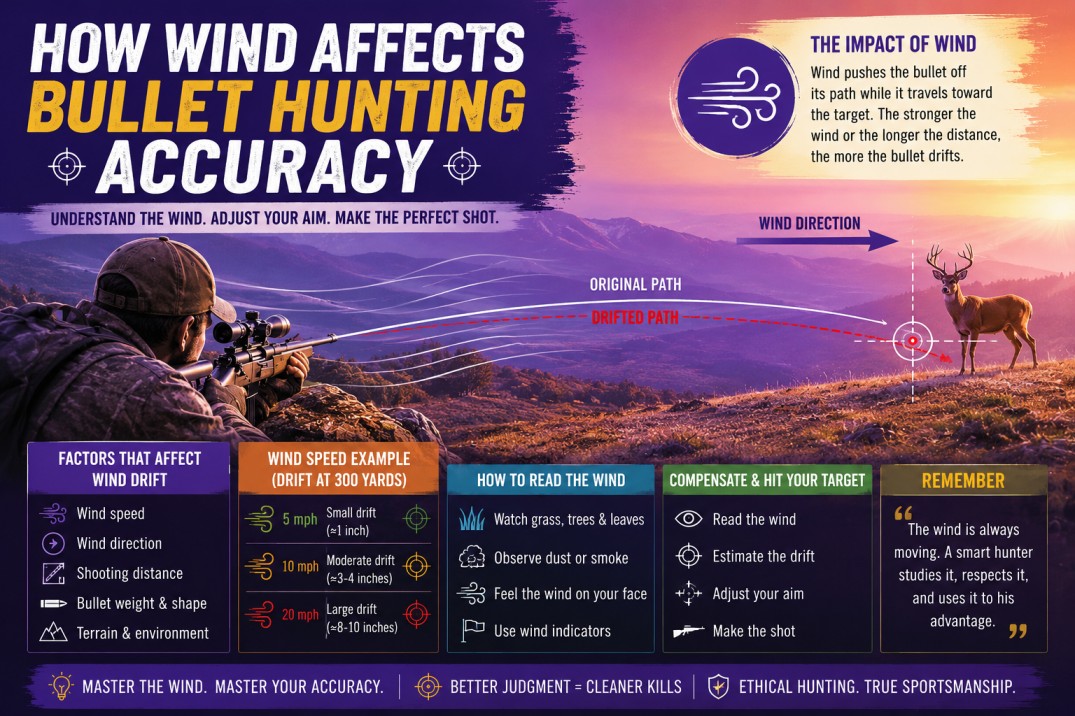
Wind drift occurs when moving air pushes a bullet away from its intended path. The amount of drift depends on several important factors.
Wind Speed
Wind speed is one of the biggest factors affecting accuracy.
A light breeze of 5 mph may only move a bullet slightly at shorter distances, but the same breeze can shift the point of impact several inches or even feet at longer ranges.
For example:
- 5 mph wind causes minor drift.
- 10 mph wind noticeably changes bullet placement.
- 20 mph or stronger winds require significant adjustment.
How Wind Affects Bullet Hunting Accuracy, Professional hunters rarely ignore wind speeds above 10 mph, especially during long-distance shots.
Wind Direction
Not all wind affects a bullet equally.
The greatest drift occurs when the wind blows directly from the left or right. These are called full-value winds.
Different wind angles produce different effects:
- Crosswind (90°): Maximum bullet drift.
- Quartering wind (45°): Moderate drift.
- Headwind: Minimal sideways movement.
- Tailwind: Slight influence on bullet speed.
Understanding wind direction allows hunters to adjust their aim more accurately.
How Wind Affects Bullet Hunting Accuracy:: Distance to the Target
Wind has more time to affect bullets traveling longer distances.
For example:
- At 100 yards, drift may only be an inch or two.
- At 300 yards, drift increases significantly.
- At 500 yards or more, even a small wind can move the bullet several inches or more.
Long-range hunters often spend as much time reading the wind as they do aiming.
How Different Bullet Types React to Wind
Not every bullet behaves the same way.
Bullet weight, shape, and velocity all influence how much wind affects its trajectory.
Lightweight Bullets
Lighter bullets travel fast but generally drift more because How Wind Affects Bullet Hunting Accuracy they have less momentum to resist wind pressure.
Advantages:
- Higher initial speed
- Lower recoil
- Good for short-distance hunting
Disadvantages:
- Greater wind drift
- Less stability over long distances
Heavy Bullets
Heavier bullets usually maintain their momentum better and resist wind more effectively.
Advantages:
- Better long-range performance
- Reduced wind drift
- Improved penetration
Disadvantages:
- More recoil
- Slower muzzle velocity
Hunters involved in Bullet hunting often choose heavier, high-ballistic-coefficient bullets for longer shots because they perform better in windy conditions.
The Role of Ballistic Coefficient (BC)
How Wind Affects Bullet Hunting Accuracy, Ballistic Coefficient, commonly called BC, measures how efficiently a bullet moves through the air.
A bullet with a high BC experiences less air resistance, allowing it to stay on course more effectively.
Higher BC bullets:
- Lose velocity more slowly
- Resist wind better
- Maintain energy longer
- Improve long-range accuracy
Lower BC bullets:
- Slow down faster
- Drift more
- Become less stable over distance
Choosing ammunition with a suitable BC can make a noticeable difference when hunting in open terrain.
Reading the Wind Before Taking a Shot
Experienced hunters rarely guess the wind.
Instead, they observe multiple environmental signs before squeezing the trigger.
Watch the Vegetation
Grass, weeds, bushes, and tree branches provide valuable clues.
Light movement usually indicates a gentle breeze.
Strong swaying branches suggest winds capable of causing considerable bullet drift.
Observe Dust and Leaves
Dust blowing across trails or leaves moving through the air reveal both wind direction and approximate speed.
Many hunters intentionally kick a small amount of dust before setting up to evaluate current conditions.
Feel the Wind
Sometimes the simplest method works surprisingly well.
Feeling wind against your face helps determine its direction.
Hunters often moisten a finger because evaporation makes wind direction easier to detect.
Use Wind Indicators
Many professional hunters carry lightweight wind meters or powder bottles.
These tools provide quick visual confirmation of air movement.
Electronic wind meters measure:
- Wind speed
- Wind direction
- Temperature
- Air pressure
These readings improve shot calculations significantly.
How Wind Affects Bullet Hunting Accuracy:: Wind Isn’t Always Constant
One common mistake new hunters make is assuming wind remains the same from the shooter to the target.
In reality, wind often changes multiple times across the bullet’s flight path.
For example:
The wind near the shooter may be calm.
Halfway to the target, an open valley could create strong crosswinds.
Near the target, surrounding trees may reduce the wind again.
This is why experienced hunters constantly observe the entire landscape instead of relying on conditions at only one location.
Terrain Creates Complex Wind Patterns
Natural landscapes influence airflow in surprising ways.
Hills
Wind speeds often increase over hilltops and decrease behind them.
Valleys
Valleys may funnel air into stronger currents, changing bullet direction unexpectedly.
Forests
Dense trees slow wind considerably.
However, openings between trees can create sudden gusts.
Open Fields
Large open spaces expose bullets to continuous wind, making long-range shots more difficult.
Recognizing how terrain shapes airflow is an important part of successful hunting.
For more:: Click here