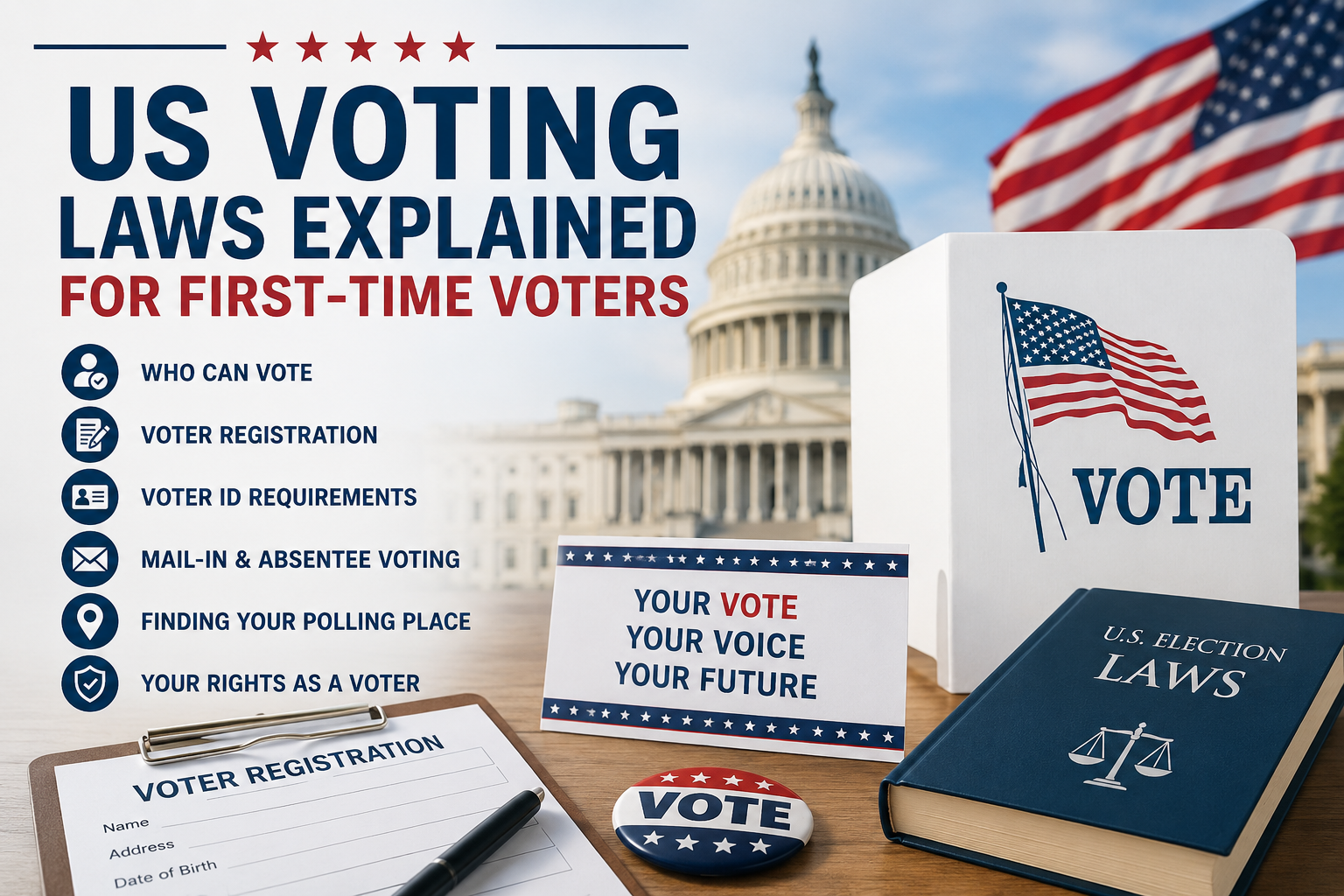
US Voting Laws Explained for First-Time Voters
US Voting Laws Explained for First-Time Voters
Voting is one of the most important ways citizens participate in a democracy. In the United States, elections determine who represents the public at the local, state, and federal levels. For first-time voters, however, the process can seem confusing. Questions about registration, voter eligibility, identification requirements, mail voting, and polling locations are common.
If you’re looking for US Voting Laws Explained, this guide provides a clear overview of the rules that govern voting in the United States. While election laws vary by state, there are also important federal laws and constitutional protections that apply nationwide. Understanding these basics can help first-time voters feel more confident and prepared when participating in an election.
Why Understanding Voting Laws Matters
Voting laws are designed to help elections operate fairly while protecting the rights of eligible voters. Learning the rules before Election Day can help you avoid common mistakes, such as missing registration deadlines or going to the wrong polling location.
Understanding election laws also helps citizens:
- Know their voting rights.
- Prepare required documents.
- Meet important deadlines.
- Understand available voting options.
- Participate confidently in elections.
For official election information, visit:
U.S. Election Assistance Commission (EAC)
https://www.eac.gov
Who Can Vote in the United States?
Although requirements differ slightly from state to state, most eligible voters generally must:
- Be a U.S. citizen.
- Meet the minimum voting age established by law.
- Satisfy their state’s residency requirements.
- Complete voter registration if required.
Some states have additional rules regarding voting eligibility for individuals with certain criminal convictions, so it’s important to check your state’s election office.
Find your state’s official election website through:
Vote.gov
https://vote.gov
Registering to Vote
One of the first steps for new voters is voter registration.
Many states allow registration:
- Online
- By mail
- In person
Registration deadlines differ by state. Some states also offer same-day voter registration under certain conditions.
The easiest place to begin is:
Vote.gov – Register to Vote
https://vote.gov/register
Understanding State Election Laws
One important aspect of US Voting Laws Explained is recognizing that elections are primarily administered by individual states.
This means rules can vary regarding:
- Registration deadlines
- Voter identification
- Mail voting
- Early voting
- Polling hours
- Ballot procedures
Always verify information with your state’s election authority rather than relying on unofficial sources.
Voter Identification Requirements
Some states require voters to present identification before casting a ballot, while others use different verification methods.
Depending on your state, acceptable identification may include:
- Driver’s license
- State-issued identification card
- Passport
- Military identification
- Other approved documents
Requirements vary, so consult your state’s election office.
Information about voter ID laws is available through the:
National Conference of State Legislatures (NCSL)
https://www.ncsl.org/elections-and-campaigns/voter-id
Different Ways to Vote
Many first-time voters are surprised to learn that there are multiple voting methods available in many states.
In-Person Voting
The traditional method involves voting at your assigned polling place on Election Day.
Early Voting
Many states offer early voting before Election Day, allowing eligible voters to cast ballots during a designated period.
Availability and schedules vary by state.
Mail Voting
Some states permit voting by mail, while others require voters to request an absentee ballot or meet specific eligibility requirements.
Check your state’s official election website for instructions.
What Is an Absentee Ballot?
An absentee ballot allows eligible voters to vote without appearing at a polling place on Election Day.
Eligibility rules differ among states.
Information is available through:
Vote.gov
https://vote.gov
Finding Your Polling Place
Polling places are assigned based on where you live.
Before Election Day, confirm:
- Your polling location.
- Poll opening and closing times.
- Any identification requirements.
- Accessibility information.
Many state election websites include polling place lookup tools.
What Happens at the Polling Place?
Although procedures vary, most voters will:
- Check in with election workers.
- Verify eligibility.
- Receive a ballot or voting instructions.
- Cast their vote.
- Submit the completed ballot.
Election workers are available to answer procedural questions.
Understanding Your Ballot
A ballot may include:
- Presidential elections
- Congressional elections
- State offices
- Local offices
- Judicial elections
- Ballot initiatives
- Constitutional amendments
Reviewing a sample ballot beforehand can help you prepare.
Many states make sample ballots available online.
Constitutional Protection of Voting Rights
Although the Constitution originally left many election details to the states, several constitutional amendments expanded voting rights over time.
Examples include:
- The Fifteenth Amendment
- The Nineteenth Amendment
- The Twenty-Fourth Amendment
- The Twenty-Sixth Amendment
These amendments prohibit certain forms of discrimination and expand voting rights.
Learn more through:
National Archives
https://www.archives.gov
Important Federal Voting Laws
Several federal laws help protect voting rights and election administration.
Examples include:
Voting Rights Act of 1965
This landmark law prohibits racial discrimination in voting.
Information:
https://www.justice.gov/crt/voting-section
National Voter Registration Act
Often called the “Motor Voter Act,” this law expanded voter registration opportunities.
Information:
Help America Vote Act
This law introduced reforms intended to improve election administration.
Information:
Accessibility for Voters
Federal law requires accessible voting opportunities for eligible voters with disabilities.
Many polling places provide:
- Accessible entrances
- Voting equipment
- Language assistance where required
- Assistance for eligible voters who request help
Information is available from:
U.S. Department of Justice – Voting Rights
https://www.justice.gov/crt/voting
Common Mistakes First-Time Voters Should Avoid
To make the voting process smoother:
- Register before the deadline.
- Confirm your polling location.
- Review identification requirements.
- Read your sample ballot.
- Allow extra time on Election Day.
- Follow official election guidance.
Preparation reduces stress and helps avoid unnecessary problems.
Avoiding Election Misinformation
Election information spreads quickly online, but not every source is reliable.
For accurate information, rely on:
- State election offices
- Vote.gov
- The Election Assistance Commission
- Official county election websites
Be cautious when sharing election-related information from unofficial sources.
Frequently Asked Questions
Can I vote if I recently moved?
Possibly, but you may need to update your voter registration depending on your state’s rules.
Is registration required?
Most states require voter registration, although procedures vary.
Can I vote early?
Many states offer early voting, but schedules differ.
What if I make a mistake on my ballot?
Election workers can explain your state’s procedures for spoiled or replacement ballots.
Final Thoughts
Understanding US Voting Laws Explained is one of the best ways for first-time voters to prepare for participating in elections. While each state administers its own elections, the basic process—registering to vote, confirming eligibility, understanding your voting options, and following official guidance—is similar across the country.
If you’re voting for the first time, start early. Register before the deadline, verify your polling location, review your sample ballot, and rely on official election resources for accurate information. By taking these steps, you’ll be well prepared to exercise one of the most important rights and responsibilities of U.S. citizenship.
For the latest election information, visit Vote.gov, the U.S. Election Assistance Commission, the National Archives, and your state’s official election website.
For more: click here