Email Marketing: Create Campaigns That Convert
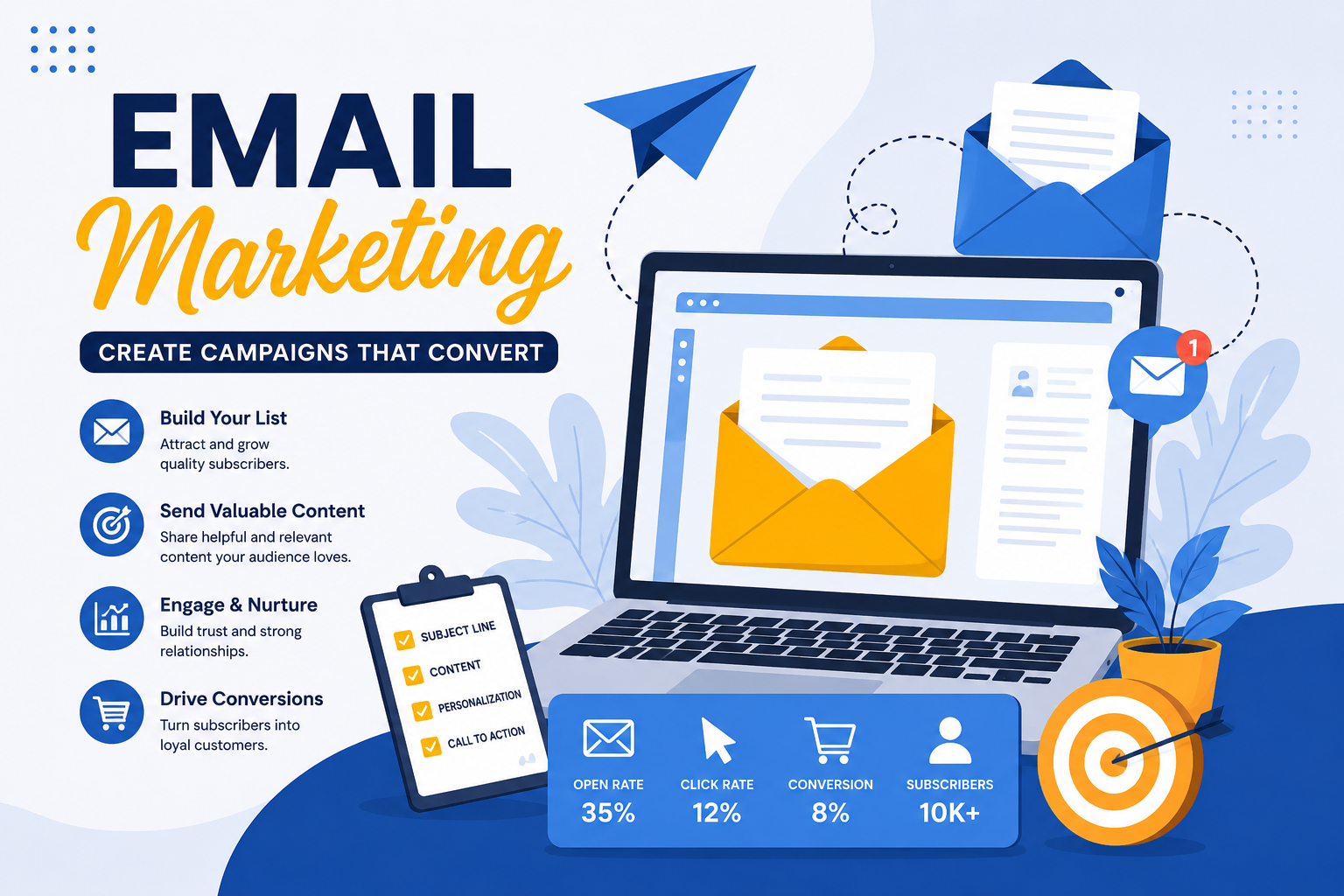
Email Marketing: Create Campaigns That Convert
Introduction
Email Marketing remains one of the most effective digital marketing strategies for businesses of all sizes. While social media platforms and search engines constantly change their algorithms, email provides a direct and reliable way to communicate with your audience. Whether you own a small business, manage an eCommerce store, or work as a digital marketer, mastering Email Marketing can significantly increase customer engagement, generate qualified leads, and boost sales.
According to industry studies, email marketing consistently delivers one of the highest returns on investment (ROI) among digital marketing channels. However, achieving these results requires more than simply sending promotional emails. Successful campaigns are built on strategy, personalization, valuable content, and continuous optimization.
In this guide, you’ll learn how to create email campaigns that convert, build a quality email list, write compelling content, and measure the success of your campaigns.
What Is Email Marketing?
Email Marketing is a digital marketing strategy that involves sending emails to prospects and customers to build relationships, promote products or services, increase brand awareness, and encourage customer loyalty.
Unlike paid advertising, email marketing allows businesses to communicate directly with people who have already shown interest in their brand. This makes it one of the most cost-effective marketing channels available.
Common types of email marketing campaigns include:
- Welcome emails
- Promotional emails
- Newsletter campaigns
- Product launch announcements
- Abandoned cart emails
- Customer retention emails
- Seasonal offers
- Re-engagement campaigns
Each campaign serves a different purpose, but they all aim to guide subscribers toward taking a desired action.
Why Email Marketing Matters
Many marketers assume social media is enough to grow a business. While social platforms are valuable, email marketing offers several unique advantages.
1. High Return on Investment
Email marketing consistently generates one of the best ROIs in digital marketing because businesses communicate directly with interested audiences instead of relying solely on paid advertising.
2. Direct Communication
Unlike social media posts that may never reach followers due to algorithm changes, emails arrive directly in subscribers’ inboxes.
3. Better Customer Relationships
Regular newsletters, educational content, and personalized recommendations help businesses build trust over time.
4. Increased Website Traffic
Every email provides an opportunity to direct readers toward blog posts, landing pages, product pages, or special offers.
5. Higher Conversion Rates
Subscribers who willingly join your email list are generally more interested in your products or services than cold audiences.
Benefits of Email Marketing
Businesses across industries continue investing in email marketing because of its long-term benefits.
Cost-Effective
Compared to traditional advertising, email marketing requires a relatively small investment while reaching thousands of subscribers.
Personalization
Modern email platforms allow marketers to personalize emails using customer names, purchase history, location, interests, and browsing behavior.
Automation
Email automation saves time by sending the right message at the right moment without manual effort.
Examples include:
- Welcome sequences
- Birthday emails
- Cart recovery emails
- Follow-up emails
- Customer onboarding
Measurable Results
Unlike many offline marketing methods, email campaigns provide detailed analytics such as:
- Open Rate
- Click-Through Rate (CTR)
- Conversion Rate
- Bounce Rate
- Unsubscribe Rate
These metrics help marketers improve future campaigns.
Building a High-Quality Email List
The success of your email marketing campaign starts with your subscriber list.
Buying email lists may seem like a shortcut, but it usually leads to poor engagement and can damage your sender reputation.
Instead, focus on growing an organic list.
Offer Valuable Lead Magnets
People willingly share their email addresses when they receive something valuable in return.
Popular lead magnets include:
- Free eBooks
- Checklists
- Templates
- Discount coupons
- Exclusive webinars
- Free trials
- Industry reports
The better your offer, the faster your list will grow.
Create High-Converting Signup Forms
Your signup forms should be simple and easy to complete.
Best practices include:
- Ask for minimal information
- Use a strong call-to-action
- Place forms on high-traffic pages
- Optimize for mobile users
- Explain what subscribers will receive
For example:
“Join over 10,000 marketers and receive weekly email marketing tips.”
Use Landing Pages
Dedicated landing pages often convert better than generic signup forms.
A good landing page includes:
- Clear headline
- Benefits of subscribing
- Social proof
- Testimonials
- Strong CTA button
Segment Your Email List
Not every subscriber has the same interests.
Email segmentation divides your audience into smaller groups based on specific characteristics.
Examples include:
- New subscribers
- Existing customers
- VIP customers
- Geographic location
- Purchase history
- User interests
- Industry
- Engagement level
Segmentation helps deliver more relevant content, increasing both open rates and conversions.
Personalization Increases Conversions
Modern consumers expect personalized experiences.
Instead of sending the same email to everyone, tailor your content.
Personalization may include:
- Subscriber name
- Company name
- Previous purchases
- Product recommendations
- Birthday greetings
- Location-based offers
For example:
Generic Subject Line
Check Out Our Latest Products
Personalized Subject Line
Sarah, Here Are Products You’ll Love
Personalized emails typically perform better because they feel more relevant to the recipient.
Write Subject Lines That Get Opened
Your subject line determines whether someone opens your email.
A great subject line should be:
- Short
- Clear
- Interesting
- Relevant
- Benefit-driven
Examples:
- 7 Email Marketing Tips That Increase Sales
- Your Free Marketing Guide Is Ready
- Save 30% Today Only
- Don’t Miss This Limited-Time Offer
- Ready to Grow Your Business?
Avoid:
- ALL CAPS
- Excessive punctuation
- Spam words like “FREE MONEY” or “GUARANTEED”
- Misleading clickbait
Trust is essential for long-term email marketing success.
Craft Valuable Email Content
After the email is opened, your content must keep readers engaged.
A high-converting email usually includes:
- A friendly greeting
- A compelling introduction
- Valuable information
- One clear call-to-action
- Clean formatting
- Mobile-friendly design
Rather than focusing only on selling, provide useful content that solves your audience’s problems.
For example, instead of repeatedly promoting a product, share practical tips, tutorials, industry insights, or customer success stories. This approach builds credibility and encourages subscribers to stay engaged with future emails.
Official Resources for Learning Email Marketing
If you want to deepen your knowledge of email marketing and campaign optimization, these official resources are excellent starting points:
- Mailchimp Marketing Resources
- HubSpot Email Marketing Guide
- Litmus Email Marketing Resources
- Campaign Monitor Resources
Email Automation: Save Time and Increase Conversions
One of the biggest advantages of Email Marketing is automation. Instead of manually sending every email, automation allows you to deliver the right message to the right person at the right time. This not only saves time but also improves customer experience and increases conversions.
Popular automated email campaigns include:
Welcome Email Series
A welcome email is the first impression your business makes after someone subscribes. It should thank the subscriber, introduce your brand, and explain what they can expect from future emails.
Abandoned Cart Emails
For eCommerce businesses, abandoned cart emails can recover lost sales by reminding customers about products they left behind. Including product images, customer reviews, and a limited-time discount can encourage them to complete their purchase.
Post-Purchase Emails
After a customer buys a product, send follow-up emails that include:
- Order confirmation
- Shipping updates
- Product usage tips
- Cross-sell or upsell recommendations
- Review requests
Re-Engagement Emails
Inactive subscribers should not be ignored. Send personalized emails asking if they still want to receive your content, offer an exclusive discount, or highlight your latest products and services.
Create Strong Calls-to-Action (CTA)
Every email should have one clear purpose. Whether you want readers to buy a product, download an eBook, register for a webinar, or read a blog post, your Call-to-Action (CTA) should make the next step obvious.
Examples of effective CTAs include:
- Shop Now
- Download Your Free Guide
- Start Your Free Trial
- Learn More
- Claim Your Discount
- Book a Demo
- Read the Full Article
Keep CTA buttons visually prominent and use action-oriented language.
Optimize Emails for Mobile Devices
A significant percentage of users read emails on smartphones and tablets. If your emails are not mobile-friendly, you risk losing potential customers.
Best practices include:
- Use responsive email templates.
- Keep subject lines concise.
- Write short paragraphs.
- Use large, easy-to-read fonts.
- Include tappable CTA buttons.
- Compress images to improve loading speed.
Always preview your emails on different devices before sending them.
A/B Testing for Better Results
A/B testing, also known as split testing, helps you identify which version of an email performs better. Instead of relying on assumptions, you can make data-driven decisions.
You can test:
- Subject lines
- CTA button text
- Email design
- Images
- Headlines
- Send times
- Personalization
- Content length
For example, compare these subject lines:
- Version A: Get 20% Off Today
- Version B: Exclusive 20% Discount Just for You
Analyze which version receives a higher open rate or click-through rate, then apply those insights to future campaigns.
Measure Email Marketing Performance
Tracking campaign performance is essential for continuous improvement. Most email marketing platforms provide detailed analytics that help you understand how subscribers interact with your emails.
Key metrics include:
Open Rate
The percentage of recipients who open your email. Strong subject lines and a trusted sender name can improve this metric.
Click-Through Rate (CTR)
Measures how many recipients clicked on links within your email. A compelling CTA and relevant content typically increase CTR.
Conversion Rate
Shows how many subscribers completed the desired action, such as making a purchase, signing up for a webinar, or downloading a resource.
Bounce Rate
Indicates emails that could not be delivered. A high bounce rate may suggest an outdated or low-quality email list.
Unsubscribe Rate
Measures how many people opted out of your emails. A sudden increase may indicate that your content is too promotional or not relevant to your audience.
Regularly reviewing these metrics helps you refine your email strategy and improve future campaign performance.
Common Email Marketing Mistakes to Avoid
Even experienced marketers can make mistakes that reduce campaign effectiveness. Avoid these common issues:
- Buying email lists instead of building an organic audience.
- Sending emails too frequently.
- Ignoring audience segmentation.
- Using misleading subject lines.
- Overloading emails with too many images or links.
- Forgetting to optimize for mobile devices.
- Failing to test emails before sending.
- Not including a clear CTA.
- Ignoring analytics and performance reports.
By avoiding these mistakes, you can build stronger relationships with your subscribers and maintain a positive sender reputation.
Email Marketing Best Practices
To create campaigns that consistently convert, follow these proven best practices:
- Build your email list organically.
- Deliver valuable and relevant content.
- Personalize emails whenever possible.
- Segment your audience for targeted messaging.
- Write compelling subject lines.
- Focus on one primary CTA per email.
- Use automation to nurture leads.
- Test different elements of your campaigns.
- Monitor campaign metrics regularly.
- Keep your email design clean, professional, and mobile-friendly.
Consistency and continuous optimization are key to long-term success.
Recommended Email Marketing Tools
Choosing the right platform can simplify campaign creation, automation, and reporting. Some of the most trusted tools include:
- Mailchimp
- HubSpot
- Brevo (formerly Sendinblue)
- ConvertKit
- ActiveCampaign
- Campaign Monitor
- Constant Contact
Each platform offers features such as email templates, automation workflows, audience segmentation, analytics, and A/B testing. Select a tool based on your business size, budget, and marketing goals.
Frequently Asked Questions (FAQs)
What is Email Marketing?
Email Marketing is a digital marketing strategy that uses email to communicate with subscribers, promote products or services, build customer relationships, and increase sales.
Why is Email Marketing important?
It provides direct communication with your audience, offers one of the highest returns on investment, supports customer retention, and helps generate consistent leads and revenue.
How often should I send marketing emails?
The ideal frequency depends on your audience and industry. Many businesses find that sending one email per week or two to four emails per month keeps subscribers engaged without overwhelming them.
What makes a good email subject line?
A good subject line is short, relevant, personalized when appropriate, and creates curiosity without being misleading.
Can small businesses benefit from Email Marketing?
Absolutely. Email marketing is affordable, scalable, and effective for businesses of all sizes. It allows small businesses to compete with larger brands by building strong customer relationships.
Conclusion
Email Marketing continues to be one of the most powerful tools for businesses looking to build lasting relationships with customers and drive measurable results. While trends in digital marketing evolve, email remains a reliable channel for delivering personalized, targeted, and valuable content directly to your audience.
The most successful email campaigns are built on a foundation of trust, quality content, audience segmentation, personalization, and continuous optimization. By growing an organic email list, writing engaging subject lines, using automation, testing different campaign elements, and monitoring performance metrics, you can create campaigns that consistently convert subscribers into loyal customers.
Remember that email marketing is not just about selling products or services. It is about providing value, solving problems, and maintaining meaningful communication with your audience. Businesses that focus on delivering helpful, relevant, and timely content are more likely to earn customer trust and achieve long-term success.
Whether you are just starting with email marketing or looking to improve your existing strategy, applying the best practices discussed in this guide will help you create more effective campaigns, increase engagement, and maximize your return on investment.
For more: click here