Explain the 2nd Amendment: Meaning and History
Explain the 2nd Amendment: Meaning and History
The Second Amendment is one of the most discussed and debated parts of the United States Constitution. Whether you’re a student, someone interested in American history, or simply trying to understand current events, it’s important to have a clear understanding of what this amendment says and how it has been interpreted over time.
Many people search online to explain the 2nd Amendment because they want a simple, factual explanation without legal jargon. While the amendment itself contains only one sentence, its meaning has been debated for more than two centuries by lawmakers, historians, judges, and legal scholars.
In this guide, we’ll explore the text of the Second Amendment, its historical background, what rights it protects, how the U.S. Supreme Court has interpreted it, and why it remains a significant part of American constitutional law today.
What Is the Second Amendment?
The Second Amendment is part of the United States Bill of Rights, the first ten amendments added to the U.S. Constitution in 1791.
Its text reads:
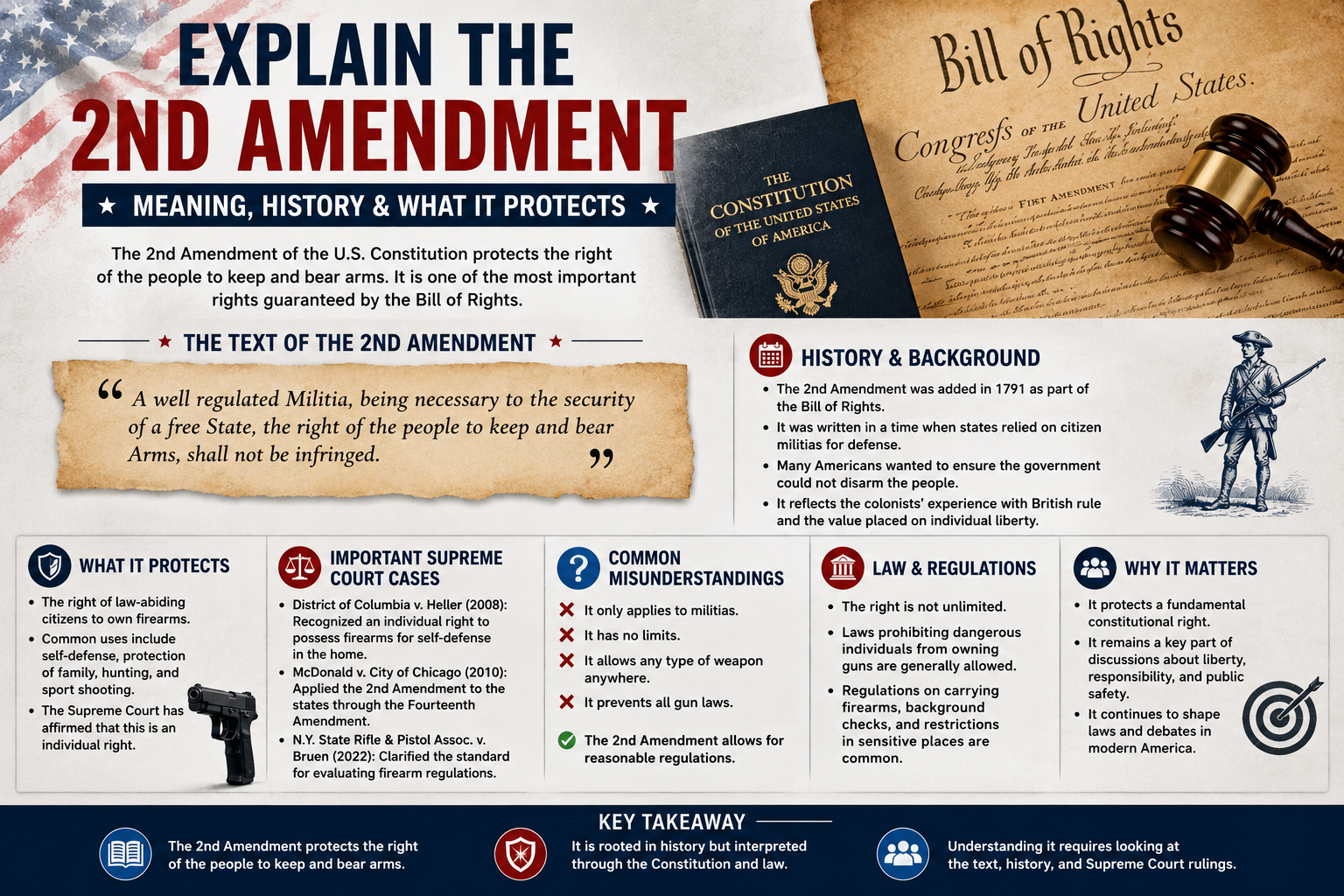
“A well regulated Militia, being necessary to the security of a free State, the right of the people to keep and bear Arms, shall not be infringed.”
Although the wording is brief, every phrase has been the subject of legal analysis and public discussion.
For the official text of the Constitution and the Bill of Rights, visit:
U.S. National Archives – The Constitution
Why Do People Search “Explain the 2nd Amendment?”
People often search Explain the 2nd Amendment because they want answers to questions such as:
- What does the amendment actually say?
- Does it protect an individual right or only militia service?
- Why was it added to the Constitution?
- How has the Supreme Court interpreted it?
- What limits can governments place on firearms?
Understanding these questions requires looking at both history and modern court decisions.
The Historical Background
To understand the amendment, it’s helpful to consider the period in which it was written.
After the American Revolution, many citizens were concerned about the possibility of an overly powerful central government. The founders debated how to protect individual freedoms while also ensuring national security.
At the time:
- States relied heavily on citizen militias.
- Many Americans distrusted standing armies.
- Firearms were commonly used for hunting, self-defense, and militia service.
These historical circumstances influenced the language that eventually became the Second Amendment.
To learn more about the founding era, see:
Breaking Down the Text
Many legal discussions focus on the amendment’s two main parts.
“A well-regulated Militia”
When the amendment was written, militias generally referred to groups of citizens who could be called upon to help defend their communities or states.
The phrase “well regulated” has been interpreted in historical context to mean something closer to “properly functioning” or “well organized.”
“The right of the people”
Another important phrase is “the right of the people.”
Elsewhere in the Constitution, this phrase is also used in connection with individual rights, which has played an important role in later legal interpretations.
“To keep and bear Arms”
This language refers to possessing (“keep”) and carrying (“bear”) arms.
Exactly how broadly these words should be interpreted has been central to constitutional debates for many years.
“Shall not be infringed.”
The final clause emphasizes that this right should not be violated.
However, courts have also recognized that constitutional rights can be subject to certain lawful regulations.
What Does the Second Amendment Protect?
One reason many readers search Explain the 2nd Amendment is to understand what protections it provides.
Modern constitutional interpretation generally recognizes that the amendment protects an individual’s right to possess firearms for lawful purposes, such as self-defense. At the same time, courts have also stated that the right is not unlimited and that governments may enforce certain regulations consistent with the Constitution.
The exact scope of those regulations continues to evolve through legislation and court decisions.
The Bill of Rights and Individual Liberties
The Bill of Rights was designed to protect important freedoms.
Examples include:
- Freedom of speech
- Freedom of religion
- Freedom of the press
- Protection against unreasonable searches
- Right to a fair trial
- The right addressed by the Second Amendment
Each amendment has been interpreted through constitutional law over time.
Learn more from:
Congress.gov – Constitution Resources
Major Supreme Court Decisions
The meaning of the Second Amendment has been shaped by several landmark cases.
District of Columbia v. Heller (2008)
In this decision, the Supreme Court held that the Second Amendment protects an individual’s right to possess a firearm for lawful purposes such as self-defense in the home.
The Court also explained that the right is not unlimited and that certain longstanding firearm regulations may still be constitutional.
McDonald v. City of Chicago (2010)
This decision held that the Second Amendment applies not only to the federal government but also to state and local governments through the Fourteenth Amendment.
New York State Rifle & Pistol Association v. Bruen (2022)
In this case, the Supreme Court addressed public carry licensing and described how courts should evaluate many Second Amendment challenges by considering the nation’s historical tradition of firearm regulation.
Information about Supreme Court opinions is available at:
Supreme Court of the United States
Common Misunderstandings
There are several misconceptions about the Second Amendment.
Myth: It only applies to militias.
Modern Supreme Court decisions recognize an individual right while also discussing the amendment’s historical context.
Myth: There can never be firearm regulations.
Courts have repeatedly explained that constitutional rights may coexist with certain lawful regulations.
Myth: The meaning has never changed.
The constitutional text has remained the same, but judicial interpretation has developed over time through court decisions.
Why the Amendment Is Still Debated
The Second Amendment remains a major topic in American public life because it touches on constitutional rights, public safety, and government authority.
Discussions often involve questions such as:
- How should constitutional rights be balanced with public safety?
- What types of firearm regulations are consistent with the Constitution?
- How should courts interpret historical evidence?
Reasonable people and legal experts may disagree on these issues.
The Role of the Courts
Courts do not rewrite the Constitution. Instead, they interpret its meaning when disputes arise.
Judges consider factors such as:
- Constitutional text
- Historical evidence
- Prior court decisions
- Legal arguments presented by both sides
This process helps shape constitutional law over time.
Why Historical Context Matters
Understanding the historical background can help explain why the amendment was written as it was.
However, history alone does not answer every modern legal question. Courts often examine both historical sources and constitutional principles when deciding cases.
How Students Can Study the Second Amendment
If you’re researching this topic for school or personal interest, it’s helpful to use reliable, primary sources.
Good places to start include:
- The U.S. Constitution
- Supreme Court opinions
- Government publications
- University law resources
- Historical archives
Avoid relying solely on social media or opinion pieces, especially for legal questions.
Understanding the Second Amendment
The Second Amendment is one of the most widely discussed parts of the United States Constitution because it addresses the right of people to keep and bear arms. Added to the Bill of Rights in 1791, it reflects the historical concerns of the nation’s founders while continuing to influence legal discussions today. To fully explain the 2nd Amendment, it’s important to look beyond its short wording and understand its historical background, constitutional purpose, and how courts have interpreted it over time. Whether you’re learning about American history, constitutional law, or current legal debates, understanding the Second Amendment provides valuable insight into one of the most significant rights protected by the U.S. Constitution.
Frequently Asked Questions
Is the Second Amendment part of the Constitution?
Yes. It is the second amendment in the Bill of Rights, which became effective in 1791.
Does it protect an individual right?
Current Supreme Court precedent recognizes an individual right to possess firearms for lawful purposes such as self-defense, while also recognizing that some regulations may be permissible.
Can laws regulating firearms still exist?
Yes. Courts have recognized that constitutional rights are not necessarily absolute and that some firearm regulations may be constitutional depending on the law and the applicable legal standards.
Why is the Second Amendment controversial?
It involves questions about constitutional interpretation, history, individual rights, and public policy, making it one of the most frequently discussed amendments in American law.
Tips for Learning More
If you want to continue studying this topic:
- Read the original constitutional text.
- Compare different Supreme Court opinions.
- Explore historical sources from the founding era.
- Read analyses from reputable educational institutions.
- Distinguish between factual reporting and opinion.
Final Thoughts
If someone asks you to explain the 2nd Amendment, the simplest answer is that it is a constitutional provision in the United States Bill of Rights concerning the right to keep and bear arms. Its language has remained unchanged since 1791, but its interpretation has developed through centuries of legal debate and landmark Supreme Court decisions.
Understanding the amendment requires more than reading a single sentence. It involves examining its historical origins, the intentions of the founding generation, the wording of the Constitution, and modern judicial interpretations. While discussions about the Second Amendment often involve differing viewpoints, studying authoritative sources and court decisions can help provide a more informed understanding.
For the most reliable information, consult official government resources such as the National Archives, Congress.gov, the Library of Congress, and the Supreme Court of the United States, all of which provide primary documents and educational materials on constitutional law.
For more: click here