AI-Powered Water Monitoring Systems
AI-Powered Water Monitoring Systems
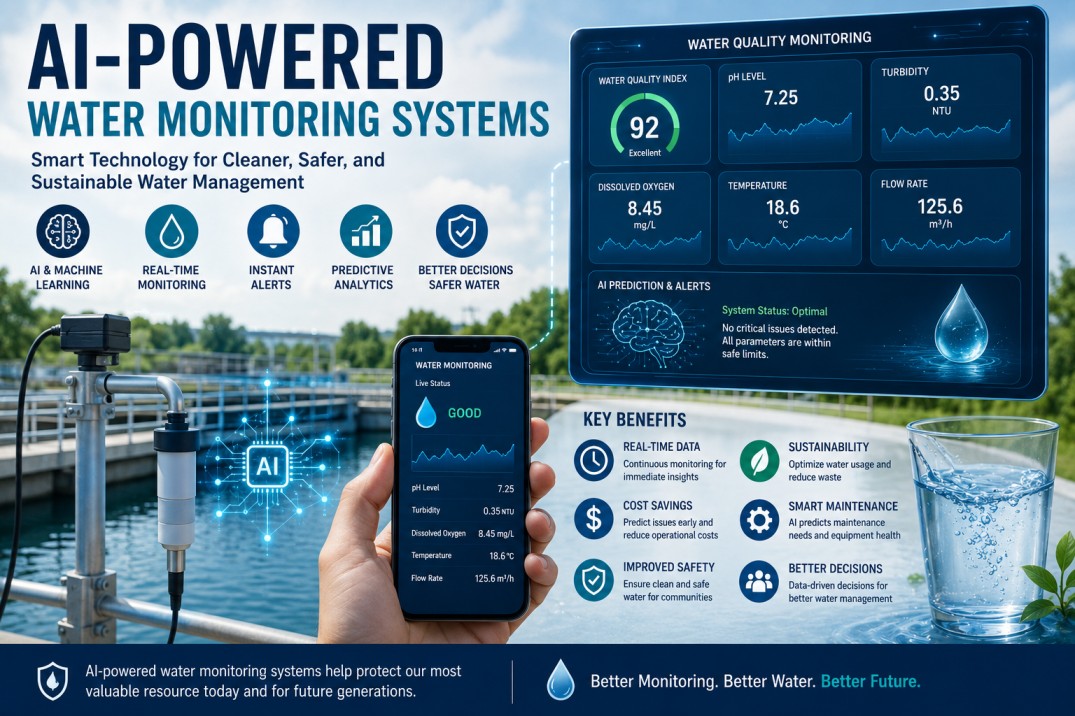
AI-Powered Water Monitoring Systems, Water is one of the world’s most valuable resources, yet ensuring its quality has become increasingly challenging. Growing populations, industrial development, aging infrastructure, and climate change have placed enormous pressure on water supplies around the globe. Whether it’s the water flowing through municipal pipelines or the drinking water in our homes, maintaining safety and quality requires constant monitoring.
Traditionally, water quality has been checked through manual sampling and laboratory testing. While these methods remain reliable, they often take hours or even days to produce results. During that time, contamination events can spread, equipment failures may go unnoticed, and valuable resources can be wasted.
This is where artificial intelligence is transforming the water industry. AI-powered water monitoring systems combine smart sensors, cloud computing, and machine learning to monitor water conditions in real time. Instead of waiting for scheduled inspections, these intelligent systems continuously collect data, detect unusual patterns, and alert operators before small problems become major ones.
For homeowners and businesses, AI technology also complements wellness water filtration systems by helping identify changes in water quality and ensuring filtration equipment continues operating efficiently. Together, these technologies provide a smarter approach to protecting water quality while supporting healthier homes and communities.
In this guide, we’ll explore how AI-powered water monitoring systems work, their benefits, real-world applications, and why they are becoming an essential part of modern water management.
What Are AI-Powered Water Monitoring Systems?
AI-Powered Water Monitoring Systems, AI-powered water monitoring systems are advanced technologies that use artificial intelligence to observe, analyze, and manage water quality automatically.
Unlike traditional monitoring methods that rely on periodic testing, AI systems gather information continuously using connected sensors installed throughout water networks.
These sensors measure important water characteristics such as:
- pH levels
- Temperature
- Turbidity
- Water pressure
- Flow rate
- Dissolved oxygen
- Conductivity
- Chlorine levels
The collected information is then processed using artificial intelligence algorithms that recognize patterns, detect abnormalities, and predict potential issues before they become serious.
Instead of simply recording data, AI actively interprets it, allowing operators to make faster and more informed decisions.
AI-Powered Water Monitoring Systems:: Why Water Monitoring Matters
Safe water is essential for drinking, cooking, sanitation, agriculture, manufacturing, and healthcare.
Even small changes in water quality can affect:
- Human health
- Industrial processes
- Wildlife
- Agriculture
- Public infrastructure
Without effective monitoring, contamination may remain unnoticed until significant damage has already occurred.
AI-powered monitoring improves response times by identifying unusual conditions almost immediately.
For households using wellness water filtration systems, early detection of changes in water quality helps ensure filtration systems continue performing as expected.
How Artificial Intelligence Improves Water Monitoring
Artificial intelligence does far more than simply collect information.
Its greatest strength lies in analyzing enormous amounts of data far faster than humans could manually process.
Continuous Monitoring
Traditional laboratory testing often occurs daily, weekly, or monthly.
AI systems monitor water every minute of the day.
This constant observation allows operators to identify changes as they happen instead of discovering problems after routine testing.
Pattern Recognition
Machine learning algorithms study historical water quality data.
Over time, the system learns what “normal” conditions look like.
If unusual readings appear, AI quickly recognizes them as potential issues.
Examples include:
- Sudden drops in water pressure
- Unexpected chemical changes
- Equipment malfunction
- Possible contamination
Predictive Analysis
Perhaps the greatest advantage of AI is prediction.
Instead of reacting after a problem occurs, AI-Powered Water Monitoring Systems AI estimates when future issues are likely to happen.
For example, the system may predict:
- Filter replacement schedules
- Pipe failures
- Pump maintenance
- Water demand fluctuations
This predictive capability reduces downtime while lowering maintenance costs.
Key Components of AI Water Monitoring Systems
Several technologies work together to create intelligent water monitoring.
Smart Sensors
Sensors serve as the eyes and ears of the system.
They continuously collect information from water sources and transmit it to central software.
Modern sensors measure multiple water quality parameters simultaneously.
Internet of Things (IoT)
IoT technology connects sensors, monitoring stations, cloud platforms, and operators.
Instead of storing information locally, data becomes available remotely through secure internet connections.
Operators can monitor water quality from:
- Smartphones
- Tablets
- Computers
- Control centers
Cloud Computing
Cloud platforms securely store enormous amounts of monitoring data.
Cloud computing enables:
- Long-term trend analysis
- Data backups
- Remote access
- Software updates
- AI model improvements
Artificial Intelligence Software
AI software analyzes incoming information in real time.
Rather than simply displaying numbers, it identifies meaningful patterns, predicts failures, and recommends actions.
Benefits of AI-Powered Water Monitoring
The advantages extend far beyond faster testing.
Faster Problem Detection
AI immediately identifies abnormal readings.
This allows operators to investigate before contamination spreads.
Improved Accuracy
Machine learning reduces human error by analyzing large datasets consistently.
As AI gains experience, its accuracy often improves over time.
Lower Operating Costs
Predictive maintenance helps prevent expensive emergency repairs.
Organizations save money by replacing equipment only when necessary instead of following fixed schedules.
Better Resource Management
AI helps reduce water waste by identifying:
- Hidden leaks
- Pressure losses
- Inefficient equipment
- Excessive consumption
These improvements conserve both water and energy.
AI and Wellness Water Filtration Systems
Residential water filtration is also becoming smarter.
Many modern wellness water filtration systems now integrate digital monitoring technologies.
Smart filtration systems can monitor:
- Filter condition
- Water usage
- Pressure changes
- Flow rates
- Maintenance schedules
Some systems even send notifications directly to homeowners when maintenance is required.
This ensures the filtration system continues delivering clean drinking water while reducing the risk of unnoticed performance declines.
Real-World Applications
AI water monitoring benefits numerous industries.
Municipal Water Utilities
Cities use AI to monitor drinking water distribution systems.
Operators receive instant alerts if contamination or infrastructure problems develop.
Industrial Facilities
Manufacturing plants monitor water used in production processes.
Consistent water quality improves product reliability while reducing equipment damage.
Agriculture
Farmers use AI to optimize irrigation systems.
Monitoring soil moisture and water availability improves crop yields while conserving valuable water resources.
Residential Homes
Homeowners increasingly install wellness water filtration systems equipped with smart monitoring features that provide real-time information about water quality and filter performance.
Environmental Benefits
Protecting water resources also protects ecosystems.
AI helps reduce pollution by detecting leaks, chemical spills, and contamination before environmental damage becomes widespread.
Earlier detection supports:
- Healthier rivers
- Cleaner lakes
- Safer groundwater
- Better wildlife protection
Technology plays an increasingly important role in long-term environmental sustainability.
Challenges of AI-Powered Water Monitoring Systems
While AI-powered water monitoring systems offer remarkable advantages, they are not without challenges. Understanding these limitations helps organizations and homeowners make informed decisions when adopting the technology.
Initial Investment
Installing smart sensors, cloud platforms, communication networks, and AI software often requires a significant upfront investment. Although long-term savings usually outweigh these costs, smaller municipalities or businesses may find the initial expense challenging.
Data Security
Because AI monitoring systems rely on internet-connected devices, cybersecurity becomes an important consideration. Protecting sensitive operational data requires secure networks, encryption, regular software updates, and strong access controls.
Sensor Maintenance
Even the most advanced AI system depends on accurate data. Sensors must be cleaned, calibrated, and maintained regularly to ensure reliable performance. If sensors provide incorrect readings, AI recommendations may also become inaccurate.
Skilled Personnel
Although AI automates many monitoring tasks, trained professionals are still needed to interpret results, perform maintenance, and make operational decisions. Artificial intelligence supports human expertise rather than replacing it.
AI vs. Traditional Water Monitoring
Traditional testing and AI monitoring each have valuable roles in maintaining water quality.
Traditional Water Monitoring
Conventional water testing typically involves collecting water samples and sending them to a laboratory for detailed analysis.
Advantages include:
- Highly accurate laboratory testing
- Comprehensive chemical analysis
- Regulatory compliance
- Well-established procedures
However, traditional methods can take hours or days before results become available.
AI-Powered Monitoring
AI systems focus on continuous observation rather than periodic testing.
Advantages include:
- Real-time monitoring
- Immediate alerts
- Predictive maintenance
- Automated reporting
- Faster decision-making
Rather than replacing laboratory testing, AI enhances it by providing continuous oversight between scheduled analyses.
How AI Supports Wellness Water Filtration Systems
As smart home technology becomes more common, wellness water filtration systems are becoming increasingly intelligent.
Modern filtration systems can now integrate with mobile applications and AI-driven monitoring platforms to improve performance and convenience.
These smart systems can:
- Track daily water consumption
- Measure incoming water quality
- Detect pressure changes
- Monitor filter performance
- Predict maintenance schedules
- Notify homeowners when filters need replacement
Instead of relying on guesswork, homeowners receive timely notifications that help keep their filtration systems operating efficiently.
This proactive approach not only improves water quality but also extends the lifespan of the filtration equipment.
AI in Smart Homes
Artificial intelligence is transforming homes into connected ecosystems where appliances communicate with one another.
Water monitoring is becoming part of this broader smart home movement.
For example, an AI system may detect a sudden pressure drop caused by a hidden leak and immediately send an alert to the homeowner’s smartphone.
Some systems can even:
- Automatically shut off the water supply during major leaks.
- Detect unusually high water usage.
- Recommend maintenance schedules.
- Track long-term water consumption trends.
When combined with wellness water filtration systems, these technologies provide homeowners with greater confidence in both water safety and system performance.
Industries Benefiting from AI Water Monitoring
Artificial intelligence is improving water management across many industries.
Healthcare
Hospitals depend on clean water for patient care, laboratory work, and sterilization procedures.
Continuous monitoring helps maintain strict water quality standards while reducing operational risks.
Food and Beverage Manufacturing
Water quality directly affects product safety and consistency.
AI monitoring ensures water remains within required specifications throughout production.
Hotels and Commercial Buildings
Large facilities consume enormous amounts of water every day.
AI helps facility managers monitor:
- Water quality
- Consumption patterns
- Equipment efficiency
- Leak detection
These improvements reduce operating costs while improving guest satisfaction.
Schools and Universities
Educational institutions use AI monitoring to provide students and staff with safe drinking water while identifying maintenance needs before they become costly repairs.
Future Trends in AI Water Management
Artificial intelligence continues to evolve rapidly.
Several emerging trends are expected to shape the future of water monitoring.
More Affordable Technology
As sensor prices continue to decrease, AI monitoring will become accessible to more households and smaller organizations.
Improved Machine Learning
Future AI systems will become even better at recognizing complex water quality patterns.
This increased accuracy will improve predictive maintenance while reducing false alarms.
Integration With Renewable Energy
Water treatment facilities increasingly use renewable energy sources.
AI can optimize energy usage alongside water management, improving overall sustainability.
Advanced Home Automation
Future wellness water filtration systems may communicate directly with other smart home devices, creating fully automated water management systems that require minimal user intervention.
Tips for Choosing an AI Water Monitoring Solution
Selecting the right system depends on your specific needs.
Before purchasing, consider the following questions:
What Do You Want to Monitor?
Some users focus only on drinking water quality, while others need complete monitoring of household or commercial water systems.
Is the System Expandable?
Choose technology that allows future upgrades as your needs grow.
Scalable systems provide greater long-term value.
Does It Integrate With Existing Equipment?
If you already own wellness water filtration systems, verify that new monitoring technology is compatible with your current equipment.
How Easy Is It to Use?
A user-friendly dashboard and mobile app simplify daily monitoring and make maintenance reminders easier to manage.
Common Myths About AI Water Monitoring
Myth 1: AI Eliminates Human Oversight
AI assists professionals by analyzing data more efficiently, but experienced operators remain essential for making final decisions.
Myth 2: AI Is Only for Large Cities
While municipalities benefit greatly from AI, homeowners, farms, businesses, and small communities can also take advantage of smart monitoring technologies.
Myth 3: Smart Systems Never Require Maintenance
Sensors, filters, communication equipment, and software all require periodic maintenance to ensure reliable operation.
Myth 4: AI Monitoring Is Too Complicated
Modern systems are designed with user-friendly interfaces that make monitoring accessible even for homeowners with limited technical experience.
Frequently Asked Questions
Are AI-powered water monitoring systems accurate?
Yes. When properly installed and maintained, they provide highly accurate real-time monitoring and can quickly detect changes in water quality.
Can AI detect water contamination?
AI can identify unusual patterns and alert users to potential contamination events. Laboratory testing may still be required to confirm the exact source of contamination.
Do homeowners need AI water monitoring?
Not every household requires advanced monitoring, but homeowners concerned about water quality, aging plumbing, or private wells may benefit significantly—especially when using wellness water filtration systems.
How often should smart water filters be replaced?
Replacement schedules vary depending on the manufacturer, water quality, and household usage. Many AI-enabled systems automatically notify users when filters require replacement.
Is AI replacing traditional water testing?
No. AI complements traditional laboratory testing by providing continuous monitoring between scheduled inspections, allowing faster responses to changing conditions.
Conclusion
Artificial intelligence is reshaping the future of water management by making monitoring faster, smarter, and more proactive than ever before. Instead of relying solely on periodic inspections, AI-powered water monitoring systems provide continuous insight into water quality, helping detect issues before they become serious problems.
For homeowners, businesses, municipalities, and industries alike, these intelligent technologies improve efficiency, reduce maintenance costs, conserve valuable water resources, and strengthen confidence in water safety. When paired with wellness water filtration systems, AI creates a powerful combination that delivers cleaner water, timely maintenance alerts, and greater peace of mind.
As technology continues to advance, smart water management will become increasingly accessible, affordable, and essential. Investing in AI-driven monitoring today is not only a step toward better water quality—it is an investment in healthier homes, stronger communities, and a more sustainable future.
For more:: click here