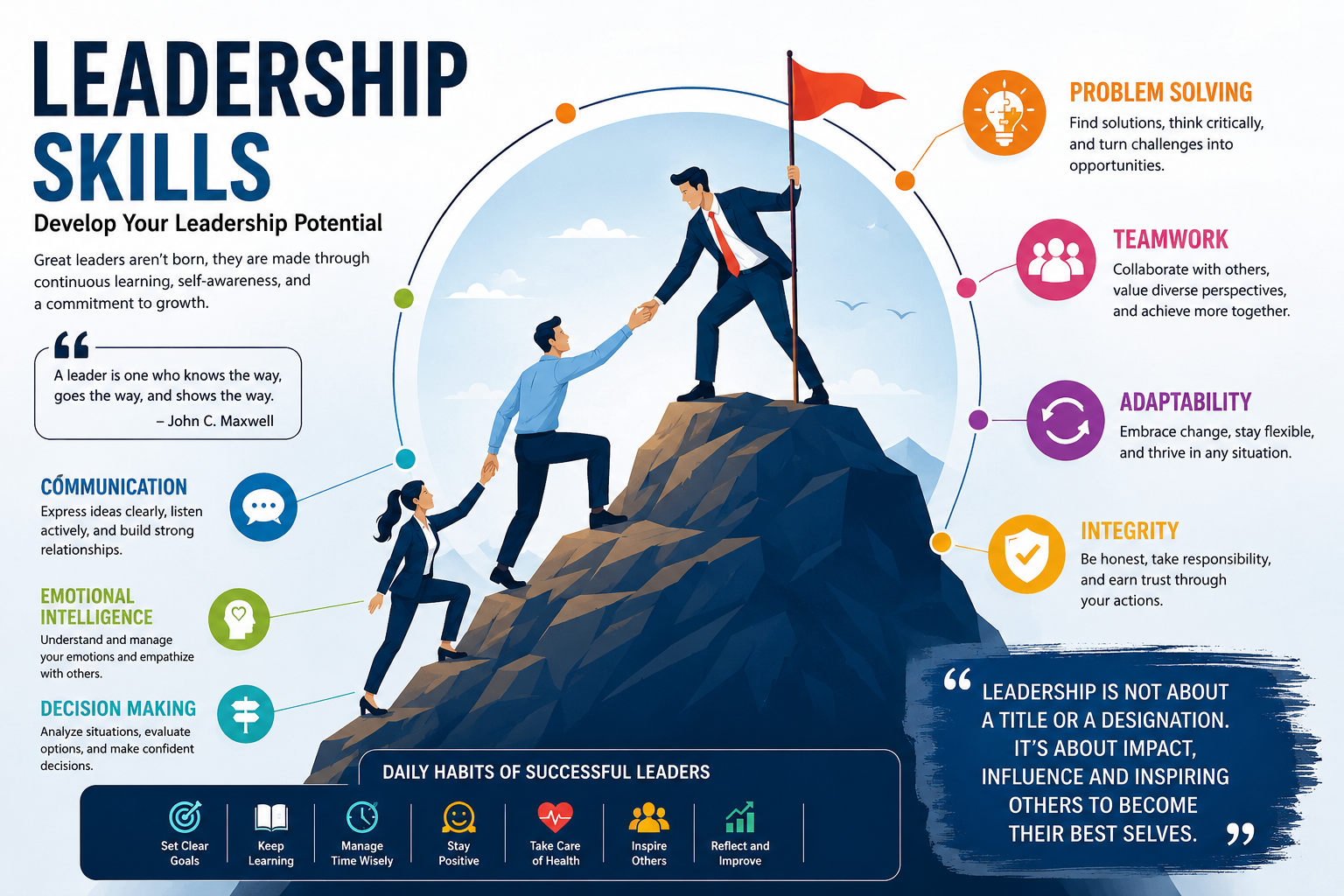
Leadership Skills: Develop Your Leadership Potential
Leadership Skills: Develop Your Leadership Potential
Introduction
Leadership skills are among the most valuable abilities anyone can develop, regardless of their profession or career stage. Whether you are managing a team, running your own business, or simply working toward personal growth, strong leadership skills help you influence others, solve problems, and achieve meaningful goals.
Many people believe that leaders are born with natural talent. However, research suggests that leadership is a combination of learned skills, practical experience, and continuous self-improvement. Anyone willing to learn and practice can become an effective leader.
According to the Center for Creative Leadership (CCL), leadership development is an ongoing process that involves improving communication, emotional intelligence, decision-making, and strategic thinking.
Official Source:
https://www.ccl.org/
In this comprehensive guide, you’ll discover what leadership skills are, why they matter, and how you can develop your leadership potential step by step.
What Are Leadership Skills?
Leadership skills are the abilities that enable a person to guide, motivate, inspire, and influence others toward achieving common goals.
These skills involve much more than simply giving instructions. Effective leaders create trust, encourage teamwork, resolve conflicts, and help others perform at their best.
The most successful leaders combine both technical knowledge and interpersonal skills to create positive outcomes for individuals and organizations.
According to Harvard Business Review, leadership is less about authority and more about influencing people through trust, vision, and communication.
Source:
https://hbr.org/
Why Are Leadership Skills Important?
Leadership skills are important in every aspect of life—not just in management positions.
Strong leadership skills help you:
- Build confidence
- Improve communication
- Solve workplace challenges
- Inspire others
- Increase productivity
- Strengthen teamwork
- Make better decisions
- Achieve career growth
Organizations actively seek employees with leadership abilities because these individuals often contribute to better performance and workplace culture.
According to LinkedIn’s Workplace Learning Report, leadership remains one of the most in-demand professional skills worldwide.
Source:
https://learning.linkedin.com/
Essential Leadership Skills You Must Develop
1. Communication Skills
Communication is the foundation of effective leadership.
Great leaders know how to clearly explain ideas, listen actively, and provide constructive feedback.
Good communication includes:
- Speaking clearly
- Listening carefully
- Asking meaningful questions
- Giving feedback respectfully
- Understanding non-verbal communication
Poor communication often leads to misunderstandings, reduced productivity, and workplace conflict.
How to improve:
- Practice public speaking.
- Listen more than you speak.
- Ask for feedback.
- Improve your writing skills.
Learn more:
https://www.mindtools.com/
2. Emotional Intelligence
Emotional Intelligence (EQ) is the ability to recognize, understand, and manage emotions—both your own and others’.
Psychologist Daniel Goleman identifies emotional intelligence as one of the most important characteristics of effective leadership.
EQ consists of:
- Self-awareness
- Self-control
- Motivation
- Empathy
- Social skills
Leaders with high emotional intelligence create healthier workplaces and stronger relationships.
Official information:
https://www.apa.org/
3. Decision-Making Skills
Every leader makes decisions every day.
Some decisions are small, while others can significantly affect an organization.
Good leaders:
- Analyze information
- Consider different perspectives
- Evaluate risks
- Make timely decisions
- Accept responsibility
Instead of avoiding difficult decisions, successful leaders learn from both successes and mistakes.
4. Problem-Solving Skills
Problems are unavoidable.
Great leaders don’t panic—they focus on solutions.
Effective problem-solving involves:
- Identifying the root cause
- Collecting facts
- Brainstorming solutions
- Evaluating options
- Implementing improvements
Creative thinking often helps leaders solve complex challenges more effectively.
5. Time Management
Time is one of the most valuable resources for any leader.
Effective leaders know how to prioritize important tasks while avoiding unnecessary distractions.
Useful strategies include:
- Planning your day
- Setting priorities
- Delegating work
- Using productivity tools
- Avoiding multitasking
The American Psychological Association provides valuable research on productivity and workplace behavior.
Source:
https://www.apa.org/
6. Adaptability
Modern workplaces change rapidly.
Technology evolves.
Markets change.
Customer expectations shift.
Leaders who adapt quickly remain successful.
Adaptability means:
- Accepting change
- Learning continuously
- Staying flexible
- Remaining calm under pressure
- Encouraging innovation
Organizations value leaders who embrace change rather than resist it.
7. Team Building
No leader succeeds alone.
Strong leaders create strong teams.
Team building involves:
- Trust
- Respect
- Collaboration
- Motivation
- Shared goals
Successful leaders recognize each team member’s strengths and encourage everyone to contribute.
Google’s Project Aristotle found that psychological safety plays a major role in high-performing teams.
Learn more:
https://rework.withgoogle.com/
8. Integrity
Integrity means doing the right thing even when no one is watching.
Honest leaders earn trust.
Employees are more likely to follow leaders who:
- Keep promises
- Accept responsibility
- Tell the truth
- Act ethically
- Treat everyone fairly
Trust is one of the strongest foundations of effective leadership.
Characteristics of Successful Leaders
Highly effective leaders often share similar qualities.
These include:
- Confidence
- Accountability
- Vision
- Humility
- Empathy
- Discipline
- Consistency
- Positive attitude
- Curiosity
- Continuous learning
Remember, these characteristics are developed through experience rather than inherited.
Leadership vs Management
Many people confuse leadership with management.
Although related, they are different concepts.
| Leadership | Management |
|---|---|
| Inspires people | Organizes work |
| Creates vision | Executes plans |
| Encourages innovation | Maintains systems |
| Focuses on people | Focuses on processes |
| Builds trust | Ensures efficiency |
The best professionals combine both leadership and management skills.
Different Leadership Styles
Every leader has a unique way of managing people. Understanding different leadership styles helps you identify your strengths and improve your effectiveness.
1. Democratic Leadership
A democratic leader encourages team members to participate in decision-making. Employees feel valued because their opinions are considered before important decisions are made.
Advantages:
- Better teamwork
- Higher employee satisfaction
- Increased creativity
- Improved communication
Learn more from Indeed Career Guide:
https://www.indeed.com/career-advice/career-development/leadership-styles
2. Transformational Leadership
Transformational leaders inspire employees to exceed expectations by creating a compelling vision and motivating continuous improvement.
These leaders focus on:
- Innovation
- Motivation
- Personal growth
- Organizational change
Many successful CEOs use transformational leadership to inspire their teams.
Learn more:
https://www.ccl.org/articles/leading-effectively-articles/transformational-leadership/
3. Servant Leadership
Servant leaders prioritize the needs of their team before their own interests.
Instead of asking, “How can people help me?” they ask, “How can I help my people succeed?”
Characteristics include:
- Empathy
- Active listening
- Humility
- Trust-building
- Community focus
Official resource:
https://www.greenleaf.org/
4. Autocratic Leadership
Autocratic leaders make decisions independently with minimal input from others.
This style may be effective during emergencies or situations requiring quick decisions, but overusing it can reduce employee motivation.
5. Coaching Leadership
Coaching leaders focus on developing their employees’ skills and helping them reach their full potential.
They:
- Provide regular feedback
- Encourage learning
- Mentor employees
- Support career growth
Organizations that invest in coaching often see higher employee engagement and retention.
How to Develop Leadership Skills
Leadership is not something you learn overnight. It requires consistent practice and a willingness to improve.
1. Improve Self-Awareness
Understanding your strengths and weaknesses is the first step toward becoming a better leader.
You can improve self-awareness by:
- Asking for feedback
- Reflecting on your decisions
- Keeping a journal
- Learning from mistakes
2. Become a Better Listener
Many people think leadership is about speaking. In reality, great leaders spend more time listening.
Practice active listening by:
- Maintaining eye contact
- Avoiding interruptions
- Asking follow-up questions
- Understanding before responding
3. Read Leadership Books
Books provide valuable insights from experienced leaders.
Some of the best leadership books include:
- The 7 Habits of Highly Effective People by Stephen R. Covey
- Leaders Eat Last by Simon Sinek
- Dare to Lead by Brené Brown
- The Five Dysfunctions of a Team by Patrick Lencioni
- Good to Great by Jim Collins
4. Take Leadership Courses
Online learning platforms offer excellent leadership training.
Popular platforms include:
- Coursera
https://www.coursera.org/ - edX
https://www.edx.org/ - LinkedIn Learning
https://www.linkedin.com/learning/ - Harvard Online
https://online.hbs.edu/
5. Practice Decision-Making
Experience is one of the best teachers.
Whenever possible:
- Volunteer to lead projects
- Solve workplace problems
- Take responsibility
- Learn from outcomes
Every decision helps build leadership confidence.
6. Learn Conflict Resolution
Disagreements happen in every workplace.
Effective leaders:
- Stay calm
- Listen to everyone involved
- Focus on facts
- Seek win-win solutions
- Avoid personal attacks
Conflict handled properly can strengthen relationships rather than damage them.
Daily Habits of Successful Leaders
Highly effective leaders often follow consistent daily habits.
These include:
Set Clear Goals
Successful leaders know exactly what they want to accomplish.
They prioritize tasks that support long-term objectives.
Keep Learning
Leadership requires continuous growth.
Read articles, attend workshops, listen to podcasts, and stay updated with industry trends.
Exercise Regularly
Physical health improves mental performance.
Regular exercise increases:
- Energy
- Focus
- Confidence
- Stress management
The World Health Organization recommends regular physical activity for overall well-being.
Manage Stress
Leadership comes with pressure.
Healthy stress-management techniques include:
- Meditation
- Exercise
- Deep breathing
- Time management
- Taking breaks
Celebrate Team Success
Great leaders recognize achievements.
Simple appreciation improves:
- Motivation
- Engagement
- Employee loyalty
- Team morale
Recognition doesn’t always require money—a sincere “thank you” often has a powerful impact.
Common Leadership Mistakes to Avoid
Even experienced leaders make mistakes.
Learning to avoid these common errors can significantly improve your leadership potential.
Poor Communication
Lack of clear communication creates confusion and lowers productivity.
Always communicate expectations clearly.
Micromanaging
Employees perform better when trusted.
Micromanagement reduces creativity and motivation.
Delegate responsibilities while providing support when needed.
Ignoring Feedback
Constructive criticism helps leaders grow.
Encourage honest feedback and act on it when appropriate.
Avoiding Difficult Decisions
Delaying decisions often makes problems worse.
Gather information, evaluate options, and make informed choices promptly.
Failing to Adapt
Markets, technology, and customer expectations constantly change.
Leaders who resist change often struggle to remain competitive.
Benefits of Strong Leadership Skills
Developing leadership skills offers numerous long-term advantages.
Career Advancement
Employers actively seek professionals who can lead teams and solve problems effectively.
Better Relationships
Strong communication and empathy improve relationships with colleagues, clients, and family members.
Higher Confidence
Leadership experience builds confidence in decision-making and problem-solving.
Improved Team Performance
Effective leaders motivate employees, resulting in better collaboration and productivity.
Business Growth
For entrepreneurs, leadership skills improve customer satisfaction, employee engagement, and overall business success.
Frequently Asked Questions (FAQs)
Can leadership skills be learned?
Yes. Research consistently shows that leadership skills can be developed through education, experience, mentoring, and continuous practice.
Which leadership skill is the most important?
Communication is often considered the foundation of effective leadership because every other leadership skill depends on clear communication.
How long does it take to become a good leader?
Leadership development is an ongoing process. With consistent effort, noticeable improvement can occur within months, but mastery takes years of practice.
Do introverts make good leaders?
Absolutely.
Many successful leaders are introverts because they tend to be excellent listeners, thoughtful decision-makers, and calm under pressure.
Is leadership only for managers?
No.
Anyone can demonstrate leadership regardless of their job title by taking initiative, solving problems, and supporting others.
Conclusion
Leadership is not defined by a title—it is defined by actions, character, and the ability to inspire others. Developing strong leadership skills requires continuous learning, self-awareness, effective communication, emotional intelligence, and the willingness to grow through experience.
Whether you aspire to become a manager, entrepreneur, team leader, or simply improve your personal development, investing in leadership skills will benefit every area of your life. Start with small daily improvements, seek feedback, embrace challenges, and remain committed to lifelong learning. Over time, these consistent efforts will help you unlock your true leadership potential and positively influence the people around you.
For more; click here