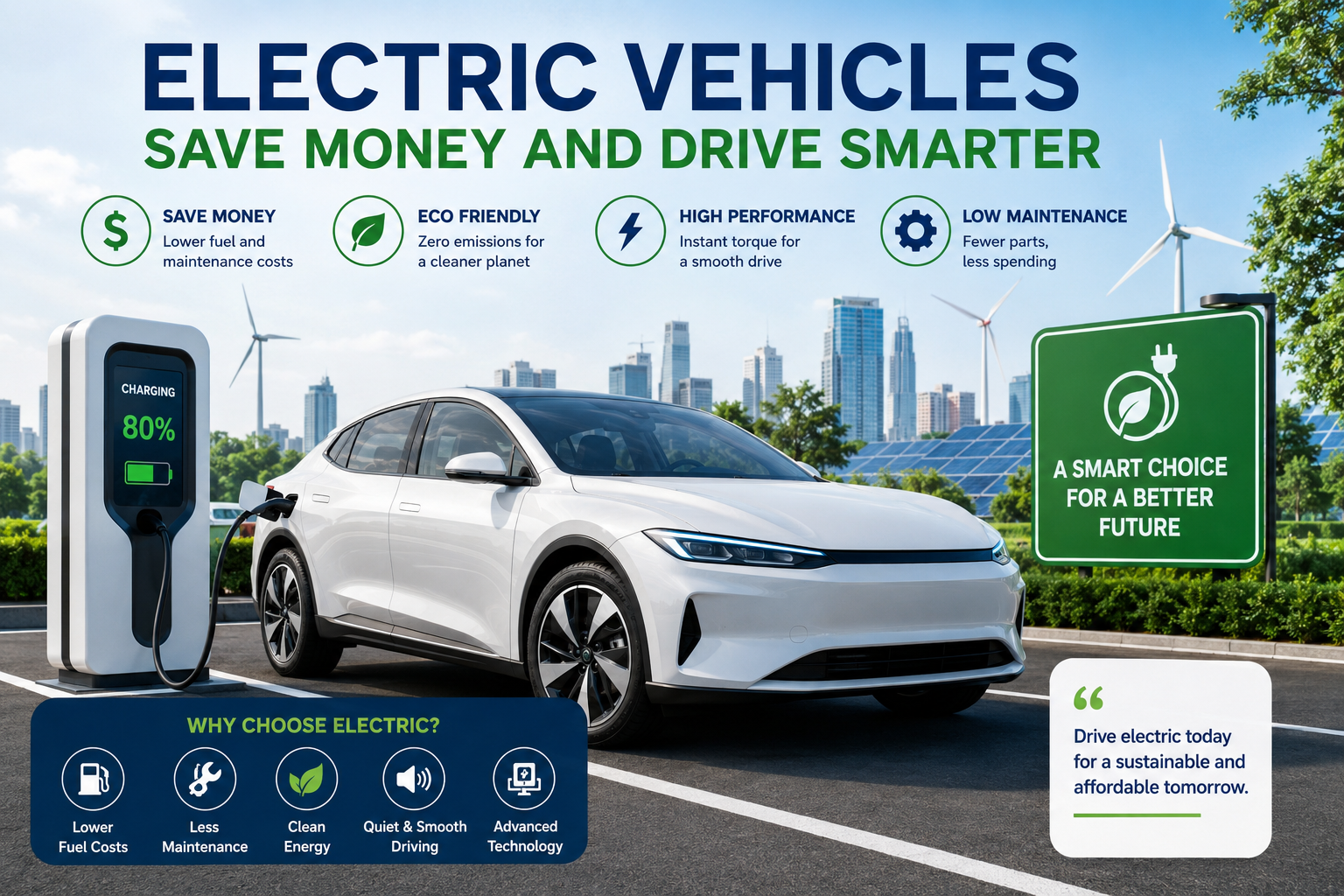
Electric Vehicles: Save Money and Drive Smart
Electric Vehicles: Save Money and Drive Smarter
Introduction
Electric Vehicles are changing the future of transportation. More people around the world are choosing electric cars because they help save money, reduce pollution, and offer a smoother driving experience. As fuel prices continue to rise and governments encourage cleaner transportation, Electric Vehicles have become one of the smartest choices for modern drivers.
Unlike traditional gasoline or diesel vehicles, Electric Vehicles (EVs) run on electricity stored in rechargeable batteries. They produce little or no tailpipe emissions, making them much better for the environment. At the same time, they require less maintenance and cost much less to operate over time.
Whether you are looking to reduce your monthly transportation costs or contribute to a greener planet, Electric Vehicles offer an excellent solution. In this guide, you’ll learn how Electric Vehicles save money, improve your driving experience, and why they are becoming the future of transportation.
What Are Electric Vehicles?
Electric Vehicles are automobiles powered by electric motors instead of internal combustion engines. These motors receive energy from rechargeable battery packs.
There are different types of Electric Vehicles available today:
1. Battery Electric Vehicles (BEVs)
Battery Electric Vehicles operate entirely on electricity. They have no gasoline engine and produce zero tailpipe emissions.
Popular examples include:
- Tesla Model 3
- Nissan Leaf
- Hyundai IONIQ 5
- Kia EV6
Official information:
- Tesla: https://www.tesla.com/
- Nissan Leaf: https://www.nissanusa.com/vehicles/electric-cars/leaf.html
2. Plug-in Hybrid Electric Vehicles (PHEVs)
Plug-in Hybrid Electric Vehicles combine an electric motor with a gasoline engine. Drivers can switch between electricity and fuel depending on battery levels.
Examples include:
- Toyota Prius Prime
- Mitsubishi Outlander PHEV
- BMW X5 xDrive50e
Official information:
- Toyota: https://www.toyota.com/
- Mitsubishi Motors: https://www.mitsubishicars.com/
3. Hybrid Electric Vehicles (HEVs)
Hybrid vehicles use both gasoline and electricity, but unlike PHEVs, they cannot be plugged in. The battery charges itself while driving.
Examples include:
- Toyota Corolla Hybrid
- Honda Accord Hybrid
Official information:
How Do Electric Vehicles Work?
Electric Vehicles use a rechargeable lithium-ion battery to store electrical energy. When you press the accelerator, electricity flows from the battery to the electric motor.
The motor converts electrical energy into mechanical energy, which turns the wheels.
Unlike traditional engines that contain hundreds of moving parts, Electric Vehicles have much simpler mechanical systems.
Main components include:
- Battery Pack
- Electric Motor
- Power Electronics Controller
- Charging Port
- Regenerative Braking System
Learn more:
https://afdc.energy.gov/vehicles/how-do-all-electric-cars-work
Why Are Electric Vehicles Becoming So Popular?
Several factors are driving the popularity of Electric Vehicles.
Rising Fuel Prices
Gasoline prices continue increasing worldwide.
Charging an EV usually costs much less than filling a fuel tank.
For many drivers, this means significant monthly savings.
Government Incentives
Many countries provide tax credits, rebates, and incentives for purchasing Electric Vehicles.
Examples include:
- Purchase subsidies
- Tax reductions
- Free parking
- Reduced registration fees
Official information:
https://www.iea.org/reports/global-ev-outlook-2024
Better Battery Technology
Modern batteries are:
- More efficient
- Longer lasting
- Faster charging
- Safer
Many new Electric Vehicles now offer driving ranges exceeding 300 miles (480 km).
Growing Charging Infrastructure
Charging stations are expanding rapidly across cities, highways, workplaces, and shopping centers.
Drivers now have more charging options than ever before.
Charging station finder:
https://www.plugshare.com/
How Electric Vehicles Save You Money
One of the biggest reasons people choose Electric Vehicles is cost savings.
Let’s look at where those savings come from.
Lower Fuel Costs
Electricity costs significantly less than gasoline.
For example:
Gasoline Vehicle
- 500 miles = $70–90 fuel
Electric Vehicle
- 500 miles = around $15–25 electricity
Actual savings vary depending on electricity prices.
Reduced Maintenance Costs
Traditional vehicles require:
- Oil changes
- Engine repairs
- Timing belts
- Spark plugs
- Fuel filters
- Transmission servicing
Electric Vehicles eliminate many of these expenses.
Maintenance generally includes:
- Tire rotation
- Brake inspection
- Cabin air filter
- Battery health checks
This can save thousands of dollars over the vehicle’s lifetime.
Regenerative Braking Saves Brake Pads
Electric Vehicles use regenerative braking.
Instead of wasting energy while slowing down, the motor converts movement back into electricity and stores it in the battery.
Benefits include:
- Longer brake life
- Better efficiency
- Lower maintenance costs
Lower Operating Costs
Since electric motors are highly efficient, Electric Vehicles convert more energy into movement.
Gasoline engines waste much of their energy as heat.
This efficiency means lower operating costs over many years.
Electricity Is More Price Stable
Fuel prices often change due to:
- Global conflicts
- Oil production
- Supply chain issues
- Market demand
Electricity prices are generally more stable, making budgeting easier.
Environmental Benefits of Electric Vehicles
Besides saving money, Electric Vehicles help protect the environment.
Zero Tailpipe Emissions
Battery Electric Vehicles produce no exhaust emissions.
This improves:
- Air quality
- Public health
- Urban pollution
Lower Carbon Footprint
When charged using renewable energy like solar or wind, Electric Vehicles can dramatically reduce greenhouse gas emissions.
Learn more:
https://www.epa.gov/greenvehicles
Less Noise Pollution
Electric motors operate quietly.
Benefits include:
- More peaceful neighborhoods
- Reduced city noise
- More comfortable driving
Better Driving Experience
Electric Vehicles provide several driving advantages.
Instant Torque
Electric motors deliver full power instantly.
This means:
- Faster acceleration
- Smooth driving
- Better city performance
Quiet Ride
Without engine noise, the cabin feels much quieter.
Passengers enjoy a more relaxing journey.
Smooth Acceleration
There are no traditional gear changes in most Electric Vehicles.
Acceleration feels seamless from start to finish.
Smart Technology
Modern Electric Vehicles include:
- Large touchscreens
- Over-the-air software updates
- Driver assistance systems
- Smartphone integration
- Navigation with charging stations
These features make driving smarter and more convenient
Charging Methods of Electric Vehicles
One of the biggest questions people ask before buying Electric Vehicles is how charging works. Fortunately, charging an EV is becoming easier every year as more charging stations are installed worldwide.
There are three main ways to charge an electric vehicle.
1. Level 1 Charging
Level 1 charging uses a standard household electrical outlet. It is the slowest charging option but works well for drivers who travel short distances each day.
Advantages:
- No special equipment required
- Low installation cost
- Convenient for overnight charging
Best for:
- Daily commuters
- Homeowners with short driving distances
Learn more:
- U.S. Department of Energy: https://afdc.energy.gov/fuels/electricity_stations.html
2. Level 2 Charging
Level 2 charging is much faster than Level 1 and is commonly installed in homes, workplaces, shopping centers, and parking garages.
Most EV owners prefer Level 2 chargers because they can fully charge a vehicle overnight.
Advantages:
- Faster charging
- Ideal for daily use
- Available at many public locations
3. DC Fast Charging
DC Fast Charging is the quickest option available today. Depending on the vehicle, it can charge the battery from about 20% to 80% in as little as 20–40 minutes.
This type of charging is especially useful for long-distance travel.
Advantages:
- Extremely fast
- Great for road trips
- Widely available on major highways
Find charging stations:
- PlugShare: https://www.plugshare.com/
- ChargePoint: https://www.chargepoint.com/
Home Charging vs. Public Charging
Choosing between home and public charging depends on your lifestyle.
Home Charging
Home charging is the most convenient option for many EV owners. You simply plug in your vehicle overnight and wake up to a fully charged battery.
Benefits:
- Convenient
- Lower electricity costs
- No waiting in line
Public Charging
Public charging stations are ideal for:
- Long trips
- Apartment residents
- Emergency charging
Many public chargers are located near restaurants, malls, hotels, and workplaces.
Battery Life of Electric Vehicles
Modern Electric Vehicles use advanced lithium-ion batteries designed to last for many years.
Most EV batteries are expected to last 8–15 years or around 100,000–200,000 miles, depending on usage and maintenance.
Many manufacturers also provide battery warranties of 8 years or more.
To maximize battery life:
- Avoid keeping the battery at 100% all the time.
- Don’t let it remain at 0% for long periods.
- Limit frequent use of DC fast charging.
- Park in shaded areas during extreme heat.
Battery care guide:
https://www.energy.gov/eere/electricvehicles
Are Electric Vehicles Expensive?
The initial purchase price of some Electric Vehicles can be higher than comparable gasoline cars. However, the total cost of ownership is often lower because of:
- Lower fuel costs
- Reduced maintenance
- Government incentives
- Fewer repairs
- Longer-lasting components
Over several years, many owners recover the higher purchase price through savings.
Common Myths About Electric Vehicles
Many misconceptions prevent people from considering EVs. Let’s look at some common myths.
Myth 1: Electric Vehicles Don’t Have Enough Range
Modern EVs often provide 250–400+ miles (400–640+ km) on a single charge, making them suitable for most daily driving and many road trips.
Myth 2: Batteries Need Frequent Replacement
Most EV batteries are built to last many years, and replacement is uncommon during the normal ownership period.
Myth 3: Charging Takes Too Long
While home charging is slower, DC fast chargers can add a substantial amount of range in under an hour.
Myth 4: Electric Vehicles Are Slow
Electric motors deliver instant torque, so many EVs accelerate faster than comparable gasoline vehicles.
Myth 5: Electric Vehicles Are Bad in Cold Weather
Cold weather can reduce driving range, but modern battery management systems help maintain performance. Planning charging stops usually addresses this issue.
Best Electric Vehicles in 2026
If you’re considering buying an EV, here are some popular options.
Tesla Model 3
The Tesla Model 3 remains one of the most popular electric sedans thanks to its impressive range, strong performance, and advanced technology.
Official website:
https://www.tesla.com/model3
Hyundai IONIQ 5
The Hyundai IONIQ 5 is known for its spacious interior, ultra-fast charging, and modern design.
Official website:
https://www.hyundai.com/
Kia EV6
The Kia EV6 combines sporty performance with excellent range and fast charging capabilities.
Official website:
https://www.kia.com/
Nissan Leaf
The Nissan Leaf is one of the most affordable and reliable electric cars, making it a great choice for city driving.
Official website:
https://www.nissanusa.com/
Ford Mustang Mach-E
The Mustang Mach-E offers SUV practicality with electric performance and a comfortable interior.
Official website:
https://www.ford.com/
Tips Before Buying an Electric Vehicle
Before purchasing an EV, consider the following:
- Determine your daily driving distance.
- Check charging options near your home and workplace.
- Compare battery range.
- Review warranty coverage.
- Calculate long-term savings.
- Consider charging speed.
- Research available government incentives.
- Read owner reviews and safety ratings.
These steps will help you choose the right vehicle for your needs.
Pros and Cons of Electric Vehicles
Pros
- Lower fuel costs
- Reduced maintenance
- Quiet driving experience
- Instant acceleration
- Environmentally friendly
- Fewer moving parts
- Advanced technology features
- Lower operating costs over time
Cons
- Higher upfront purchase price for some models
- Charging takes longer than refueling
- Public charging infrastructure varies by region
- Range may decrease in very cold or hot weather
- Home charger installation may add extra cost
The Future of Electric Vehicles
The future of Electric Vehicles looks promising. Governments, manufacturers, and technology companies continue investing in cleaner transportation.
Future developments may include:
- Longer battery range
- Faster charging
- More affordable EV models
- Expanded charging infrastructure
- Improved battery recycling
- Greater use of renewable energy for charging
- Enhanced autonomous driving features
As battery technology improves and production costs decline, EVs are expected to become even more accessible.
For industry insights:
- International Energy Agency (IEA): https://www.iea.org/reports/global-ev-outlook-2024
Frequently Asked Questions (FAQs)
Are Electric Vehicles cheaper to maintain?
Yes. Electric Vehicles generally require less maintenance because they have fewer moving parts and do not need services such as oil changes.
How long does it take to charge an EV?
Charging time depends on the charger:
- Level 1: 20–40 hours
- Level 2: 4–10 hours
- DC Fast Charging: About 20–40 minutes to reach roughly 80%
How long do EV batteries last?
Most EV batteries last 8–15 years or 100,000–200,000 miles, depending on usage.
Are Electric Vehicles good for long trips?
Yes. Many modern EVs offer long driving ranges, and the growing network of fast chargers makes road trips increasingly practical.
Do Electric Vehicles help the environment?
Yes. They produce no tailpipe emissions, improve air quality, and can reduce greenhouse gas emissions when charged using renewable energy.
Conclusion
Electric Vehicles are transforming the way people travel by offering a cleaner, smarter, and more cost-effective alternative to traditional gasoline-powered cars. Although some models may have a higher upfront price, the long-term savings on fuel and maintenance often make them a worthwhile investment.
With improvements in battery technology, expanding charging infrastructure, and increasing government support, Electric Vehicles are becoming more practical for everyday use. Whether your goal is to save money, reduce your environmental impact, or enjoy a modern driving experience, an EV can be an excellent choice.
As the automotive industry continues to innovate, Electric Vehicles are expected to play a major role in the future of transportation. Choosing an EV today is not only an investment in your finances but also a step toward a more sustainable future.
For more: click here